During my sophomore year of college my fraternity was shut down. As a result, all of our events were canceled and to make matters worse we couldn’t even participate in other organized events within the Greek system.
This sucked. It was a huge problem especially for my group of friends who enjoyed going out and doing the social thing.
But where there was a problem, there was also a solution.
At this point in time, my friend and I decided to build a college marketing company that would encompass three themes: (i) host events in a safe and secure environment (ii) be honest and upfront with our partners and vendors (iii) create recognizable and memorable marketing events that would promote the company brand in a positive and unique light.
In the short aftermath of my fraternity’s suspension, we hosted our first event. The first was all it took. It gave us some confidence, experience, and most importantly, momentum. From that point on we were able to grow the business, form new partnerships, hire more help, and keep the ball moving forward.
We were beginning to be featured in the local newspapers and magazines and were starting to become a focal point of the local community’s social scene:
“Yet another alternative to Freakfest is Runaway Productions Halloween 2006, the first event of its kind to be held at Madison Avenue. Runaway Productions, a company run by UW students, organized this 18-and-up event with Sony/BMG Music Records and CO-ED Magazine to provide an alternative environment for those in search of a riot-free good time. According to Managing Partner Daniel Reich, the Halloween 2006 event was created as a “legitimate venue so people can party in a safe, controlled environment.” Instead of wandering around aimlessly amid the drunken antics of State Street, students will have the opportunity to dance to their favorite artists at the dance club on University Avenue.
Runaway Productions intends to appeal to all sorts of listeners with a variety of musical acts. Hip-hop, reggae and rock fill the bill with artists including Golden, Collie Buddz, Fahrenheit and Displace. Also performing is special guest Sa-Ra from Kanye West’s record label GOOD. The event runs tonight and tomorrow, and attendees can purchase tickets from ExchangeHut.com.”
(Disclosure: Sa-Ra never came and the headliner was Collie Buddz. It was his first live US show. One of his songs here)
At the end of the day, “the first” was all it took. Although we did many events and functions thereafter, “the first” is what really put us over the top. It is probably the hardest thing to do when starting a business or doing sales, but once one is knocked down, the rest just kind of fall into place.
Sidenote: It’s been three years since we parted with Runaway Productions and three years later it is still going strong.
This is a damn small world. The Internet makes it that much smaller. Just read the title of this post as proof (or see entire comment here from another Daniel Reich).
For the rest of your life, everything you do and say will be public information and will be easily accessible. You can argue with me all you want but 10 years from now, if by some chance I recall that argument and feel like being in a “I told you so” mood, I’ll be sure to take your most embarrassing picture and make it its own website just to remind you how right I was.
Ok, I probably won’t do that (even though I or anyone else could).
The point is that in today’s world you must control and own your own web presence.
Go to Google, type in your name, see what comes up.
Myself and fellow rescuer assessing the scene and pateint (Mount Snow, Vermont)
This October will mark my 9th consecutive year as an emergency health care professional. In all those years, the most important thing I learned (besides teamwork) is that assessing a situation correctly and completely could literally be the difference between life and death. The “assessment” is the most critical aspect when saving lives, treating the injured, or tending to the ill. Emergency health care or health care in general, is the most seriousness business of all (other than war), and within this business, great “assessment” skills are absolutely necessary.
Now think about your own life for a second. Think about your job, your company, your family, your significant other. How could you improve any one of these things if you spend a little more time observing or assessing, before you act or do anything? Think about the job of a manager, quant, marketer, or salesman? As an example, how much better could a salesperson be if they spent more time understanding a business’ needs, before they blindly push a product onto a prospective client?
With that in mind, consider the following few paragraphs:
As a salesman, you must perform a quick but thorough assessment to identify a prospect’s needs and to provide proper business solutions. Prospect assessment includes many steps and is the most complex skill that you will learn in the field. To make the task easier, it is helpful to identify and discuss the key components and skills of prospect assessment before you learn the entire process.
As you begin your assessment, you must gather and record some key information about the prospect. You will also need to obtain and evaluate the prospect’s vital signs of their business. The failures, struggles, or needs and the history of what occurred before and since you arrived are key pieces of information that you will have to obtain by asking a series of questions. You must also learn about the prospect’s past history and overall health of the business.”
Gathering Key Prospect Information
You will need to know which questions to ask and how to ask them. By using your deductive powers, you will be able to interpret the meaning and implications of your findings and the information that you have gathered. When assessing the prospect, you will have to look, listen, feel, and think.
Point is, you can’t possibly solve a problem or address an issue, without fully understanding the problem in the first place. In health care, this could possibly mean death. In business and in relationships, this could possibly mean failure.
Think, assess, and only after, act.
“As a rescuer, you must perform a quick but thorough assessment to identify a patients needs and to provide proper emergency care. Patient assessment includes many steps and is the most complex skill that you will learn in the OEC (Outdoor Emergency Care) course. To make the task easier, it is helpful to identify and discuss the key components and skills of patient assessment before you learn the entire process.
As you begin your assessment, you must gather and record some key information about the patient. You will also need to obtain and evaluate the patient’s vital signs. The injuries, illnesses, or symptoms and the history of what occurred before and since you arrived are key pieces of information that you will have to obtain by asking a series of questions. You must also learn about the patient’s past medical history and overall health.”
“Gathering Key Patient Information
You will need to know which questions to ask and how to ask them. By using your deductive powers, you will be able to interpret the meaning and implications of your findings and the information that you have gathered. When assessing the patient, you will have to look, listen, feel, and think.”
(Outdoor Emergency Care, Comprehensice Prehospital Care for Nonurban Settings, 4th Edition)
By “Real Vacation” I mean: Do whatever you have to to clear your mind. Don’t think about anything. Think about nothing.
I recently came back from a long week in Mexico (Riviera Maya – Secrets Capri) and it was indeed a REAL vacation. I highly recommend it as a “Real Vacation” spot.
A “Real Vacation” is not a trip to Las Vegas, it is not a trip to Montreal, it is not a ski or snowboard trip (although my mind is pretty clear when I do those things), it is not a trip or visit back to college or a road trip to a sporting event.
In this day in age, it’s nearly impossible to escape. I’d argue that 80% of your day is spent with your phone or computer. Whether or not your are using it, its there. You are thinking about it. Thinking about who is going to call you or text message you. And because you are thinking about it, you happen to break it out and read the news, send someone a message because your board, or check Facebook.
And if your not thinking about the next possible message vibrating out of your phone, your thinking about work, your family, your significant other, the television show you watched last night.
I also hear people talk about how they have ADD or ADHD, and while some may very well indeed have chemical imbalances, the rest of us are just ADD brainwashed because of how much multi-tasking occurs in our daily lives. Some Buddhists call this “Monkey Brain.” We call it ADD.
All of this put a huge strain on your physical and mental self. We call this stress.
Do yourself a favor. When you get a chance, take a REAL vacation and clear your mind. You’ll thank me when you do.
I created this video a while back for one of my college classes. It’s amazing how far an industry has come in such a short period of time. Even crazier to think that it’s only getting started.
The Internet and technology makes it so easy to do anything.
Want to be a musician? Grab a mic, plug it into your computer, hit record.
Want to make a movie? Grab a camera, edit on your computer.
Want to be a journalist? Create a blog, start writing.
Want to learn a new language? Download language software.
Want to be an artist? Draw a picture and make it available online.
Want to invent something? Sketch an idea and outsource production?
Want to be in finance? Use the latest in market analysis software.
Point is, as technology makes our lives easier it also becomes easier for anyone anywhere, to create something of value for the rest of us to use or consume. It really is incredible.
As a result, we’ve seen this mass explosion of user generated [fill in the blank] because the barriers of entry to do anything are being reduced every single day. This creates an overwhelming amount of information, ideas, music, movies, businesses, services or whatever else you can think of. There are so many options and so many choices. How are you supposed to know what’s best or most relevant to you? How are we supposed to know what’s right or wrong, good or bad, true or false? I mean, people actually thought actor Jeff Goldblum died because they read it on Twitter (video below).
With all of this noise creation comes an opportunity to create filters or smart methods of aggregation. A sort of Meta-Business if you will. This concept isn’t new, but the methods that will be used will be.
Some quick examples:
Brazen Careerist – Aggregates “top Gen Y thought leaders” thereby filtering the noise of all the other junk of us millennial
StockTwits – Aggregating all of the stock market conversation using Twitter, and more recently have begun aggregating a network of top financiers
The Hype Machine – Collection of music from all over the world both user generated and by well known artists
Lotame – A collection of consumer insights and web properties, that allow advertisers and marketers to pick the most relevant consumer segments for their marketing needs (Disclosure: My current employer)
I typically use this blog for somewhat coherent thoughts. When I see things I like and don’t have time to write about them, they either make it to my tumblr account, or to my twitter & Facebook update.
Here are some of those quotes from the past few months:
“creativity, which I define as the process of having original ideas that have value, more often than not, comes about through the interaction of different disciplinary ways of seeing things”
“The goal is not to be better than the other man, but to be better than your previous self.”
— An old Hindu proverb
“You see things and say ‘Why?’ I dream things and say ‘Why not?’”
— George Bernard Shaw
“Entrepreneurs are simply those who understand that there is little difference between obstacle and opportunity and are able to turn both to their advantage.”
— Nicollo Machiavelli
“Ranting is how you get the sludge out of the way so the genius can slide out on greased skids.”
A recent study came out by Knowledge Networks titled: “Internet users turn to social media to seek one another, not brands or products.” Without even looking at the numbers, I think it’s safe to bet that it is in fact true that “Internet users turn to social media to seek one another, not brands or products.” There are two parts to every statistical experiment: 1) The design and 2) the analysis. In the case of this study, it is a bit troubling to see how biased the experiment is without even reading past the title. What do you think the results would be if I put out a report titled: “Music lovers turn to radio to seek music, not brands or products”, or “Movie lovers turn to movie theaters to seek great new movies, not brands or products.”
The reason marketers are so concerned with “Social Media” is because they realize that this is where users spend most of their time. This is where they “seek one another” to connect, engage, and share (in many cases about brands and products). According to a report from The Nielsen company, which, was distributed at San Francisco Ad tech:
“The Internet remains a place of continuing innovation, with users finding new ways to integrate online usage into their daily lives,” said Charles Buchwalter, SVP, Research and Analytics, Nielsen Online. “In recent years the Internet has changed dramatically as people seek more personalized relationships online. In particular, time spent on social networks and video sites has increased astronomically. Advertisers are starting to positively re-assess the value of the online experience and create more meaningful relationships with consumers.”
The number of American users frequenting online video destinations has climbed 339% since 2003. The unique audience for online video surpassed that of email in November 2007.
Time spent on video sites has shot up almost 2,000% over the same period.
In the past year, unique viewers of online video grew 10%, the number of streams grew 41%, the streams per user grew 27% and the total minutes engaged with online video grew 71%.
There are 87% more online social media users now than in 2003, with 883% more time devoted to those sites.
In the past year, time spent on social networking sites has surged 73%.
In February 2009, social network usage exceeded web-based e-mail usage for the first time:
It is a marketer’s job to penetrate the most popular mediums, and make their brands or products visible in the most efficient fashion. In today’s world, Social Media is the most popular medium and it is stillgrowing. So indeed, while users go to Social Media to “seek more personalized relationships“, it will still be a marketer’s job to try and penetrate this medium in efficient and meaningful ways. If a marketer can be successful in creating brand affinities with products in social media (which Lotame has had much success in doing – one example), then everyone wins as the consumer is able to find relevancy and the marketers are able to reach their target audience.
We used to live in what I will call a Media Dictatorship. A Media Dictatorship is a world where content is created by a few dictators (media companies), and as a result, those few dictators are able to charge a premium to advertisers for access to the eyeballs and ears of the people watching that premium content. This process is called television, radio, print, magazines, and newspapers. Think about the Super Bowl and Super Bowl commercials for a second. One night a year, content providers or dictators (the cable network hosting the Super Bowl) know that they will have an entire country watching their show, and as a result, they are able to charge a fortune to advertisers for a 30 second commercial. According to the Associated Press, a 30 second spot for the 2008 Super Bowl was $2.7M dollars. On this night, everyone knows that millions of eyeballs and ears will be tuned in, and so, advertisers are willing to shell out some big bucks for the opportunity to reach all of those viewers (according to a Nielsen report, there were 97.5M viewers of the 2008 Super Bowl). In this world, the world of a Media Dictatorship, the dictators own the distribution of the content, and therefore they own your attention.
Today we live in a very different world. A world that I will call a Media Democracy. A Media Democracy is a world where content is created by anyone, and as a result, those people are able to charge whatever they would like. However in this world, in this Media Democracy, the people that own the distribution do not force their content on the people (see Google). These distribution owners let the people choose what they watch or listen to and as a result, attention isn’t owned but earned. In order to accrue lots of eyeballs and ears, the content must be compelling and the people must be willing to share. And unless there are lots of eyeballs, it is very difficult for the people to charge advertisers anything at all. Consider that YouTube video that you loved, but only has about 100 views. Although the content may be awesome, 100 views is of little significance to big brand advertisers. Now consider that YouTube video that your friend told you about. The video that you would of never heard of had that friend not said anything to you. Turns out, this video has 100M views. Guess who made money off of this video? No one. There was no $2.7M commercial for 30 seconds. The video itself was only 55 seconds, and yet for 55 seconds, this video had the attention of almost 100M viewers. This was a mini Super Bowl event that happened organically, grew virally, and was controlled by no one. A true democracy.
Welcome to the new age of the internet. Open, distributed, democratized. More specifically, welcome to YouTube. At any given point in time a video could experience a Super Bowl-like event or what I rather refer to as a Black Swan event.
There has been a lot of talk recently on how to make money from YouTube videos or User Generated Content (UGC) videos, especially after seeing YouTube’s inability to make money off of the recent pop sensation Susan Boyle.
As Simon Cowell might say, this story is utterly disappointing and self-indulgent. But the fact that YouTube and ITV have been unable to monetize the Internet sensation that is Susan Boyle is a rather significant blunder, and highlights some of the archaic ways that business is still done between old and new media. – Mashable, Susan Boyle Video Profits: $0
In the Media Dictatorship, media companies know with good certainty how many viewers they have. In the Media Democracy world, no one knows with any certainty how many viewers there will be. In lies the monetization and advertising dilemma with UGC videos or anything viral online. How do you make money off of videos that MIGHT be huge successes? How could an advertiser possibly know what videos are going to be a hit and go “viral”?
Bottom line: They can’t.
So now what? We know there is a ton of potential in videos that have millions of views, but the question still remains:
In a broad sense: How can advertisers capitalize on media that goes viral?
Solution: Selling dynamic advertising access based on first order traffic derivatives.
In a specific sense: How can advertisers capitalize on viral YouTube videos?
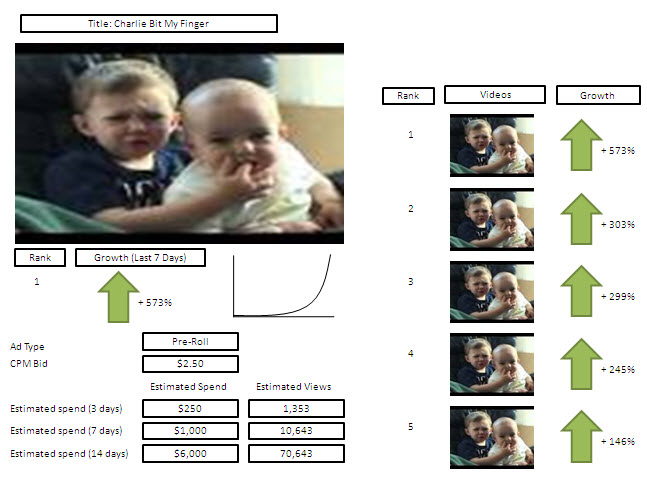
Solution: Selling dynamic advertising in YouTube videos based on the growth rates of video views.
Imagine for a second that an advertiser has the ability to place an advertisement (overlay, video ad, pop up, etc) in a YouTube video at any given point in time during the life of that video. For all intents and purposes, an advertiser can throw an ad in a video, however they want, whenever they want.
Would the advertiser place the ad at the beginning life cycle of the video? Do they try and intuitively gauge how successful the video might be? Would you put up $3M on a video that may or may not be seen by more than 100 people?
Would the advertiser place the ad at the end of the video’s life cycle? After the video has been seen 100M times? Would you put up $3M on a video that may or may not have peaked in popularity?
The answer is no in both examples.
The real solution here is to place that $3M on videos that:
Meet the advertisers target audience (the type of video: comedy, horror, sports, etc)
KEY: Have the highest growth rates for a certain period of time.
By inserting advertisements into videos that are experiencing the highest growth rates, marketers could benefit from the “viral” effect of videos. The $3M would only be spent as the video increases in popularity. The video will no longer be judged based on “top rated” or “most viewed”, but instead, will be judged and purchased by marketers based on “most growth” (The interface might look something like the image below).
Ultimately, if marketers are to capitalize on the “viral” effect they must start to look at the viral aspects of media or videos, and buy them according to their growth or “viral” potential as the growth is happening.
Starting a business is very hard. In a matter of 24 hours your emotions can range from thinking that your business will be the next Google, to thinking how moronic you were for even contemplating the idea in the first place.
In order to start a successful business, I believe you need two components above all else.
1. A Team
Collective knowledge is more powerful than any one individual. But I believe Eric Schmidt puts it best:
“How should you behave? Well, do things in a group. Don’t do things by yourself. Groups are stronger, groups are faster. None of us is as smart as all of us…..” – Eric Schmidt, CEO Google.
2. The Entrepreneurial Snowball Effect
Beyond having a team, you need a group of people that can feed off of each other. People that together, build continual momentum regardless of the challenges by feeding motivation to and from others in the group. If one person starts some momentum, others can build and build upon it until slowly, that once “idea” begins to grow into reality.
From my experiences, most people have great ideas but fail to see the execution through all the way. And the few that do see execution through quickly stop at the sight of any real obstacles (I’ve been guilty of both in the past).
If your lucky enough to find the right team with an entrepreneurial snowball effect, take your idea and just build something.