I’ve been spending a lot of time lately thinking about Facebook and the implications it has on our daily lives, our communications, and our buying behavior. I’m starting to come around to the belief that Facebook truly is, first and foremost a data company in addition to being a portal for social news and activity. That’s really it and its nothing we don’t already know. Facebook will most certainly evolve and offer more compelling features like daily deals, FB credits, or even a mobile OS, but at the core, their foundation is simple. My friend Brad has been thinking about what this means in the context of historical companies and products, so I extended this line of thinking to see what I’d come up with and here is where I currently stand.
AOL vs. Facebook AOL was first and foremost an ISP in addition to being a closed portal to various content and communications channels. Users were able to log in to their AOL account and then immediately access things like their AOL profile (what is now Facebook), their Instant Messaging and away messages (what is now Twitter), their news (what is now every news site out there), their mail (what is now GMail), their games (what is now Zynga), their chat rooms (what is now BBM, SMS, Meebo), etc. What started off as an ISP quickly became a portal for various components of one’s digital experience and to me, this is starkly similar to Facebook.
Facebook on the other hand started out as first and foremost a data company in addition to being a portal to various social content and news feeds. Users are able to log into their Facebook account and engage their entire social network of friends. Perhaps the biggest difference between Facebook and AOL is that Facebook lets users carry their identity with them online, while AOL did not. So today, if a user wants to read the news, or play games, or chat with their friends, they can do so under a uniform identify that is portable across many digital platforms. To me, this is nothing more than a driver’s license for the web which in time will become a credit card for the web.
With this said, I think its interesting to see what happens when you slightly modify the rules of open vs. closed. AOL was a very closed environment and it was only a matter of time before it got hacked up into new, competing companies. Facebook however, although still very much closed, is enabling others to access its rich database thus making it a platform for a greater social web – a Driver’s License. Other than that, I’m not sure what other interesting take aways we can learn from this comparison.
Microsoft vs. Facebook Microsoft was a software company built to manage productivity and utility. At its core, it had an operating system that enabled specific apps which were all designed, in some way shape or form, to enhance one’s ability to be productive by leveraging digital connections on the internet, and within the very PC (between memory, the hard disk drive, CD rom, etc). Productivity was the key word here and it fueled 10 years of growth (e.g. MS word, excel, IE, Powerpoint, etc).
On the other hand, Facebook is a data company built to manage and facilitate social connections. At its core, it is a centralized data base that houses self-declared information (e.g. age, gender, location, interests, etc), and on top of that data base, it has apps that are designed to leverage these pieces of information (e.g. groups, walls, friend recommendations, etc). “Social Connectivity” is the key word here and i think we can agree that it will fuel the next 10 years of growth.
With this said, I think the Microsoft vs. Facebook comparison is a little better than the AOL analogy but I’m still not sure it does us justice to understand the full effects of Facebook. I don’t think we should look at Microsoft as the comparison to gauge what Facebook means, but instead, I think we should be looking at historical events that involved social movements. Things like voting, protesting, activism, wars, diplomacy, fundraising, emergencies & triage (healthcare), events, etc. I think the next wave of innovation (on the consumer side of things) will be about taking timeless human events (like buying things) and overlaying a precise data set and pure social connectivity layer (e.g. Facebeook). Because in each one of these social events, there are very different use cases, with a very different way of using and looking at the data.
As we continue to build our business at spinback we continue to engage in a number of very interesting conversations on the topic of product recommendations and sharing. Jared Spiegel, a friend of mine and someone who is currently participating in the Brooklyn Law Incubation Program (BLIP), made the following point that I thought really highlights the core of why product sharing is so valuable. His point is this:
Suppose you are interested in purchasing a new bike. The single most important thing that you are looking for is durability and reliability. That is, you don’t care about looks, design, or wheel style – what you do care about is the frequency of repair. As a reasonable and sensible person, you consult Consumer Reports and learn that the bike with the best repair record is clearly a Schwinn. No other bike even comes close. Naturally, you decide that the next day you are going to buy a Schwinn bicycle.
Suppose that the night before you are going to make your purchase, you are at dinner with a few friends where you announce your intention to buy a new bike. One of your friends at the table says “I just bought a Trek bicycle last week and I love it! It’s much better than my rusted, beat-up Schwinn. In fact, I’ve never been so happy with a bike in my life!”
Let’s suppose that the ranking you read on Consumer Reports was based on a sample of 1,000 bike owners. Your friend’s preference for his Trek bike (and distaste for his old Schwinn) has increased the size of the sample to 1,001. It has added one negative case to your statistical bank. Logically, this should not affect your decision. But a large body of research indicates that such occurrences, because of their personal character and connection between the purchaser and the source of the information, assume far more importance than their logical, statistical status would imply. All other things being equal, most people are more deeply influenced by one clear, personal example than by an abundance of statistical data.
So even if there is a large data set that crunches consumer reviews looking for the very best product, it really only takes a focus group of one and a personal connection to influence someone’s buying decision.
My friend Jeremy suggested that people take his blog post titles and write their own story. Considering I just finished drawing pictures and diagrams on a whiteboard for 4 hours, I thought this title was most appropriate. And the fact that I’m writing this post at 3am on a subway should add a little more color to just how much mental lubrication white boards can account for.
Truth is, ideas come and go. I know this because I have an ongoing ideas spreadsheet that has many, many ideas but I also know 98% of them will never see the light of day. At least not because of me. And this simple truth is really the difference between an idea and something that is tangible. It’s being able to take the lofty, grandiose idea and turn it into reality. And doing that is not easy. At all. Its hard, risky, time-consuming, and it’s entirely probable that it will fail.
So what do you do? I say, “fuck it” (as I listen to dirty south hip hop on my iPod). Win or fail, I’ll at least try, and it will start with a 4 hour, lubricated white board sessions. KY style.
A family friend of mine owns a large men’s clothing store and for the purpose of this story, we’ll call this store TuxMan. For years, TuxMan would sell suits, ties, shoes, belts, tuxedos and the like to hundreds of customers. He had great products, great customer service, and great tailors. In fact, his service was so good that customers wanted to bring in their own non-TuxMan clothes to get tailored, but he said no. His store policy was that TuxMan would only tailor clothes that were purchased in the TuxMan store. This logic made complete sense and it worked for years. After all, why would he want to do some tailoring for someone else’s product?
Well in the midst of the financial crisis his sales were on a decline. All of a sudden, businessmen no longer wanted to buy new suits. There were fewer customers in the store and lots of suits just hanging around.
So what did TuxMan do when sales started to slip?
Advertise more aggressively?
Offer insane discounts?
Nope…
They let customers bring in their non-TuxMan clothes and have them tailored by his team. All of the businessmen who no longer wanted to buy new suits wanted to get more use out of the suits and shirts they already had. So sure enough, new customers came in the door, got their suits tailored, refitted and upgraded them and then, something great happened. These new customers that did not want to buy anything new ended up buying new accessories for their non-TuxMan suits they were having tailored. Instead of shelling out a few hundred dollars for a new suit, they bought new ties, shoes, and shirts to make their old suits look new. And all of a sudden, sales increased, the number of loyal customers increased, and eventually, more suits left their hangers and went home with happy customers.
If you are in college you should start your own business because there is no better time to do so.
When I was in college working on thecampusatlas.com I remember thinking how great it was to have the flexibility of a student and to have the resources of a college university in order to get things done. I was surrounded by exceptionally bright people from all different backgrounds and areas of expertise who were willing to provide guidance.
“There is no better time to start a company than when you’re in school,” he said.
After all, college students don’t require a lot of money, their housing often is paid for, and their peers often are willing to hustle at all hours to meet deadlines. “You can’t beat that when you need to have your attention focused on the company,” he wrote in an e-mailed response to a question.
Furthermore, academic institutions have the resources to educate entrepreneurs on any single area of a business or topic and by leveraging the various academic resources to build your business, you actually obtain a wider knowledge base of information then originally intended.
As a student, you have the ability to build your own business in a safe, low-cost, resource-rich environment and if it doesn’t work out you still hedged your bet because you’ll most likely graduate with a degree.
As a grandson of a holocaust survivor, I have a very specific lens by which I view the religion of Judaism. As a student of technology and media, one of the millennial generation, I also have a specific lens by which I view the intersection of religion and our present day culture. A culture that is driven by real time communications, personalization, social networking and extreme amounts of multitasking. This post is about that intersection between religion and present day culture as it relates to philanthropic outreach in the Jewish community.
Recently, there has been debate in the philanthropic Jewish community about how Judaism can be relevant and provide substantive educational opportunities to its members. It is the idea that by using smart outreach programs the Jewish religion can become a more important role in the lives of many. A recent article by Edgar M. Bronfman frames this debate by discussing intermarriage while referring to the recent marriage of Chelsea Clinton and Marc Mezvkinsky and ultimately, he concludes that:
We must do more than open the doors to newcomers in the Jewish community: We must reach out to them.
But I’m afraid this point is of little practical use to the folks in charge of doing the outreach and to the folks that must ultimately create meaningful connections with the members of the community. To date, the philanthropic Jewish community has relied heavily on issues such as the Holocaust and antisemitism to create a connection, but in a world where survivors are less in numbers and in a world where antisemitism is as commonplace as air, finding new “issues” to leverage is becoming increasingly difficult. Add in the fact that today’s communications are literally living off of 140 character messaging systems (e.g.Twitter) and new languages like, “idk how 2 make sense of all diz, LOL” and you have a recipe for a, dare I say, indefinite fast of successful outreach programs.
So, what are the Jewish Federations, the Hillel’s, the Jewish Day School, the Yeshivas, or any other religious entity for that matter supposed to do in today’s environment where the goal is outreach?
Ultimately, I think it boils down to 3 main components that if understood, could help shape the future for these groups and its respective communities.
1. Understanding Judaism, Facing Reality – Cultures and Traditions vs. Religion and Laws
I was recently asked the following question by a coworker of mine:
Which is more important to you and Why? The Culture and Traditions of being jewish or the religion?
What is important about this question is not the question itself. What is important however is the fact that there is a distinction between culture and religion. It is the fact that these two topics are viewed as very separate entities. With that said, the very first thing that must be done when asking questions like “How do we keep our children Jewish?” or “How do we make Judaism relevant” is to understand what in fact it means to be Jewish.
When I was on birthright this past year it was very clear that people were there for different reasons and people connected with Judaism for different reasons. As I said earlier, my “Judaism Lens” is painted with dark colors due to my connection with the Holocaust but there are many instances of bright colors as well. And those bright colors, for me, circle around family, traditions, culture, and love for one another. This is a very different view than someone who attends temple every day for daily prayers.
With that said, I believe that Judaism today fundamentally falls into two groups: Cultures and Traditions vs. Religion and Laws. And before any “outreach” can be organized, it is necessary to understand which group is being targeted. So which group matters? Asked another way, which group is bigger and can make a difference through network effects? When I was asked the earlier question by my coworker “which is more important,” I responded with “Culture and Traditions, hands down” to which she responded, “Couldn’t agree more. I dont believe in religion. I do however believe in Community and tradition.” This is the reality we live in and it must be understood and embraced.
2. Understanding Cultural Influences – Mass Media and “Push” vs. Personalization and “Pull”
America is a Santa Clause nation. Just look outside and you’ll see Christmas trees and Christmas decorations. Turn on the TV and you’ll see advertisements that wish you a Merry Christmas while other, less frequent advertisements wish you “Happy Holidays.” And like the Jewish religion, there are no doubt those who celebrate Christmas that really don’t have an affinity to the religion itself per se, but do in fact love the traditions, holidays and customs. Let’s face it, when I was younger I remember asking my parents for a Chanuka bush due to the cultural influences around me. We also hung up blue Chanuka stockings above the fireplace.
Now let’s consider these two, brief stories as a contrast: Neil Lazarus, an “internationally acclaimed expert in the field of Middle East” and strong advocate for Israel gave a talk and in it described his relationships with Judaism while he was growing up as a child in Britain, and later, described his relationship as an adult and as a father. He said that as a child he had no real connection to Judaism and as adult, still had little connection to the religion itself. However, as a father, one day his children came home from school and touched their hand to the mezuzah upon entry. This was not something he taught them, yet due to their cultural surroundings, his children absorbed this cultural act and subconsciously ingrained it into their daily lives.
The second story is about a colleague of mine who is not Jewish, although he still sends his children to Jewish day school because that particular school is one of the best in the area in terms of pure academics. His children came home from school one day and begin to sing Jewish songs. Again, this is another instance where the daily cultural surroundings affect the behavior of an individual. The song singing is second nature and happens as a result of cultural surroundings and influences, which in this case, is a day school that conveys Jewish traditions from the early morning until the afternoon.
The point is, in both stories the cultural influences are a result of “mass” media. It is the situation where for better or worse, a certain theme dominates the others due to its sheer size of distribution and presence. It is no different than listening to the radio and all you hear is Kanye West when pretty soon, you subconsciously begin singing “and I ain’t messing with no gold digger.” This happens because the content is “pushed” to you over the airways. This same concept applies to other mass media channels like broadcast television and print.
But we now live in a world where “mass” media is on the decline and “me” media is on the rise. Sites like Facebook, Twitter and Youtube let you personalize your experience and “pull” in the content you desire. In today’s world, people are able to curate their own experience and define their own cultural existence from behind their computer or from their mobile phone. Consider the fact that, according to eMarketer:
Consumers now spend as much time on their mobile devices as they spend reading print newspapers and magazines—combined. And while time spent on mobile devices grew 28% in 2010 to reach an average 50 minutes per day, time spent reading print magazines and newspapers decreased 9% in 2010.
We are now at a place where the conversation is bi-directional. This is a place where we can easily engage and interact with small groups or large groups of people in very unique, customized, and personal ways. But in order to fully leverage these new mediums for outreach, activists must be smaller, nimbler, more tactical, and must be prepared to experiment with new forms of communications.
3. Actionable Measures to Influence Personalized Culture
Now that we understand the need to properly segment the audience and understand the need to adopt newer communication strategies, we must look at some specific examples and consider their implications so we can learn from them and use them to influence future philanthropic outreach strategies. These will all be brief.
Example A: A Public Service Announcement not approved by AJWS (link here – embedded below)
Watch the video below. It’s great. It’s funny. As of this writing there have been about 630,000 views of the video with most views coming from the United States. If we assume that there was about 1 view per person, than that’s about 630,000 people that watched this video. Furthermore, if we assume that all of these views were by people who are Jewish, than that means about 10% of all Jews living in America saw this video. Not too bad if your goal is to strengthen a relationship with a Jewish audience.
I heard a story recently of someone who, after seeing this video, disclosed the fact that they were Jewish to another person. That’s power. This video is powerful. It illicits strong personal feelings of emotion and joy to the point of public action. From this example, we can see that humor is a powerful motivator and should be considered in outreach programs.
Example B: Candlelight – The Maccabeats – Hanukkah (link here – embedded below)
My sister sent this video to me. She is 20 years old. At the time of this writing there have been 3.6M views and if we use my logic from above, that means roughly half of all American Jews have seen this video. More powerful than the video above perhaps. But more importantly, I think the value of this video lies in its creation. This was a group of students that banded together to express themselves in song and video using Judaism as the content. There are a number of other examples of this artistry as well. Take for example the Wu Tang Clan’s member, Remedy Ross. A Jewish rapper who created a song called “never again” referring to the Holocaust. Or the more famous example, Adam’s Sandler’s “Chanuka Song.” But the artistry is not the important point here. The important aspect is that it is very easy to create independent and creative content and easily share it with the world. This sort of behavior can be used in classrooms and can be used as incentive to drive behavior. This concept should also be considered by philanthropic activists.
Example C: e-Cards & Digital Notes
There is an entire library of Hanukkah cards available at Someecards.com. It is dead simple for people to send each other messages using these types of lightweight technologies. This same tactic can be used with text messages as well because after all, who doesn’t carry a mobile phone these days? The point here is that lightweight, easy to use, easy to deploy notes and messages should be considered to stay top of mind and should be used on a frequent basis.
Facebook pages are not the end all be all. They are simply a way to aggregate a group of like-minded individuals in one place. A focus group of sorts. From there, it is up to the group moderator to stir up the conversation.
Twitter is just a short message real time communication system. Some people using twitter, like Amare Stoudemire, have a pretty decent amount of followers. This is a powerful tool if the right person is saying the right things to the right people.
Example F: Other
There are plenty of other tactics that can be used for Judaic outreach, but unless comprehensive strategies are used on the right people, in the right way, and with the right message, successfully deploying philanthropic outreach programs will be nearly impossible. I hope this blog post helps paint a better picture of Judaic Philanthropy in the Facebook world.
Madison, Wisconsin could very well be the next hub for startup businesses. When I was in school in Madison, I watched companies like Microsoft and Google open offices on campus in order to tap into the vast pool of engineering talent. The thing is, Madison goes beyond engineering and has very bright, motivated people looking to build the next “big thing.”
My friend Nathan is one of those people and he has had some nice success stories around building businesses. Moreover, he’s got a fresh outlook on what it takes to get things done, and more importantly, why he is doing what he is doing. This one will also be filed under “Student Profiles.”
Student Bio – Nathan Lustig
I’m the cofounder of Entrustet, a website that allows you to decide what you’d like to happen to your digital assets when you pass away. I graduated from the University of Wisconsin in 2009 with a degree in Political Science. While I was a student, I started a tickets and textbooks trading website and grew it to 150,000 users and sold it to my ad network. I also love sports, traveling, cooking and eating good food.
Dan Reich: Why are you an entrepreneur? Nathan Lustig: I’m an entrepreneur because I learned at a young age that I really didn’t like the structure of school and being forced to do things that I thought were boring or useless. I was really bored in school growing up and always looked for interesting things to do. When most of my friends got traditional jobs in high school, I started reffing soccer when I was 12, cut lawns and figured out ways to make money. I was always starting things or looking for ways to improve existing products and quickly realized that I would hate living and working in a cubicle.
When I got to college, I bought and sold tickets my freshman year and realized that there was room for a well run website to organize the market. After being in business for a month, I knew there was no way I would be getting a “real” job anytime soon. I love the freedom, the new challenges every day and trying to create something that I know will help people in their day to day lives.
DR: What is entrustet all about? NL: Entrustet is a free service that allows you to create a list of your digital assets (online accounts and computer files) and then decide if you’d like them transferred to heirs or deleted when you pass away. We came up for the idea after reading Thomas Friedman’s The World is Flat. He talks about a US marine who was killed in Iraq and his family wanted access to his Yahoo! account. Yahoo! said no and after a court battle, a judge ruled that Yahoo! had to turn the contents of the Marine’s email over to his parents.
We thought this was crazy. You shouldn’t have to go to court to gain access to a loved one’s digital assets. We also thought that there may be some assets that you’d rather keep private. The court case showed that your online accounts and computer files are real assets that should be dealt with during the estate planning process. Fast forward to 2010. Domain names, blogs, family photos, email, contacts, twitter and other digital assets dominate our daily lives.
We also work with attorneys to teach them how to add digital assets to wills and trusts. A few months back, my cofoudner Jesse Davis and I were the first people in North America to execute traditional wills with our digital assets included. It’s fairly easy for attorneys to add digital assets to estate plans, but most don’t because they don’t know how to do it. We teach attorneys and then certify that they know what they are doing.
The last piece of Entrustet deals with websites. Websites have no idea when their users pass away and don’t know what they wanted done with their accounts either. This leads to poor customer service, wasted resources and potential legal liability from identity theft, among other things. For example, three Facebook users die every single minute and Facebook has no idea who they are or what they wanted done with their profiles. We help websites by notifying them when their users pass away and what the user wanted done with their account.
Our goal is to help people deal with digital death so that they don’t lose valuable digital assets when they pass away.
DR: Why are you trying to start a business in Madison, WI, and more importantly what’s the deal with your relocation to Chile? NL: I’ve lived in Madison for the past six years now and love it. It’s got a great University and high quality of life. While I was running my tickets/textbooks website, I’ve gotten to know pretty much everyone in town, so it was natural that we started our next business in Madison. Plus, it’s really cheap. I rent a 3 bedroom with a lake view for $1050 per month, total, for all three of us, utilities included. We rent awesome office space just off the Capitol Square for $250 per month. The money we raise goes MUCH farther here than in NYC or San Francisco.
The Chilean government wants Santiago to be South America’s startup hub, so they are offering foreign startups $40,000 and free office space to move there for up to six months. I applied after reading about the program in Forbes and applied on a lark. We got picked and after talking with our advisers, partners and investors, we decided to make the move. We think the Startup Chile program offers us some awesome networking opportunities, plus I’ve always wanted to live in a Spanish speaking country to get fluent in Spanish.
My partner Jesse and I do most of our work online or on the phone, so we don’t envision all that much changing. Chile is EST+1, so the time difference is minimal and we’re a direct flight away from NYC and 1 stop from San Francisco.
DR: What are you thoughts on Madison, WI as a technology or startup hub? NL: Madison is already a technology hub, but for the past decade or so, it’s been in biotech. Over the past six years, it’s becoming an emerging IT startup hub as well. Madison was just named the 7th most innovative city in the US and I think it’s what Boulder was 6ish years ago and Austin 8ish years ago. In May 09, I started an entrepreneur meetup group called Capital Entrepreneurs. We had 10 web startups at our first meeting and now we have 65 in the group. Madison is starting to get on the map, with articles in TechCrunch and Read Write Web and Madison companies like JellyFish, Networked Insights, Alice, Brazen Careerist, PerBlue, Asthmapolis and other getting national play. Here’s some other Madison startup resources:
Facebook Foodcourt – Tried to create an online ordering website inside Facebook in 2007
Madison Independent Realty – Tried to create a website that would allow college students at UW to find houses not owned by the big property management companies. Failed because we couldn’t get the property managers to pay us anything to list in 2005.
Segway Sharing – Tried to do a shared segway system on UW campus in 2008, realized it would cost too much and people feel self conscious riding them.
Mobile Tickets – I wanted to build a mobile app that would show people buying and selling tickets in real time, in your area. The tech wasn’t there in 2006/7, but it is now. Someone please build this. It would be awesome.
I’m sure there’s more, but those are the ones that are coming to mind right now.
DR: Where do you see yourself in 5 years? NL: I really have no idea. I’m sure I’ll be doing something entrepreneur related, but 5 years seems really far off. As you can see by the Chile move, I hardly know where I’ll be in 6 months, much less five years. I hope I’m doing something fun, interesting and useful. At some point I really want to work on something education related, but I’m not sure when.
There is no doubt in my mind that our dependency on mobile phones will continue to increase. I’m not going to try and justify this statement because this is quite simply a fact, and with that fact comes a tremendous amount of opportunity. A friend of mine has been digging into this space and I thought his current approach, tactics and projects were worth sharing.
David Alson shares his insights below in another post I’ll file under “Student Profiles.”
Student Bio – David Alson
David Alson was born and raised in the New York City area and is currently a senior at Miami University in Oxford, Ohio. He is studying Electrical Engineering and Computer Science, with hopes to pursue a career in the technology industry after graduation in the spring of 2011.
Dan Reich: I understand you’ve developed some iPhone apps. Could you talk a little bit about those, and your experiences in creating them? David Alson: During the summer of 2009, I bought an introductory book on iPhone programming and started teaching myself how to build apps. I built some basic apps to get used to the environment and Objective-C, learn about the Cocoa Touch framework and experiment with features of the iPhone I have never programmed for before, such as the accelerometer, camera and touch screen.
The first app that I released to the App store was a generic countdown to the 2010 New Year. I wanted to put something in the store so I could see first hand what the process was like and how the App store made and recorded sale transactions.
The second and third app that I put in the store was a game with a free version with ads and a 99-cent version called BallFall, which I decided to make for two reasons. The first reason was because I wanted to see how much I had taught myself about iPhone programming. I figured creating a game would be the most fun in the end and also be something that I would be willing to put in the store after it was done. The second reason was because the games category is the most successful category in the App store and I wanted to see how well ads do in free apps.
DR: What projects are you working on now? DA: In addition to my electrical engineering course work, several projects I am currently working on include the Miami University App, Track ‘M, which will be integrated into the Miami App, and my first mobile game, BallFall.
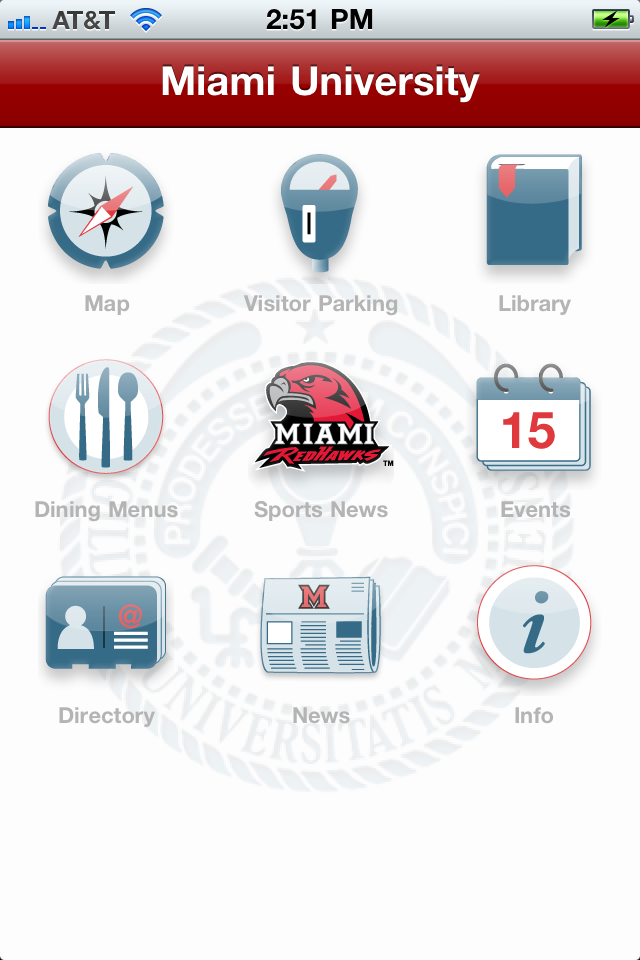
The Miami University App was designed for current students, perspective students and parents, all Miami University faculty members, and especially new freshmen in need of a portable assistant to help with the transition into their new collegiate lifestyle. Some features of this app include a map of campus with building information, visitor parking information, dining menus to see what is being served in the dining halls across campus, sports and events news and a directory to search for contact information for all students, faculty and staff at the university.
Track ‘M is projected to be a live GPS bus tracking system for the Miami University transit system. This application is currently being designed to be incorporated into the Miami University App so those interested in accessing and utilizing the MU transit system will be able to access and view live locations of each bus and receive approximate bus arrival times at the desired destination.
Lastly, BallFall, which as previously mentioned, was designed as a personal examination of various aspects of the mobile market and a way to examine my own abilities with Objective-C. I am currently working on introducing an online leaderboard to feature high scores, which I decided to incorporate after taking a class on web services and SOA. I anticipate its release within the next couple weeks.
Those projects can be seen below.
DR: Where do you see the biggest opportunities in the mobile space? DA: I believe there are two areas that have high potential for opportunity and growth within the mobile space—the medical industry and the education system. With a huge percentage of the population carrying mobile devices now, the medical industry has an opportunity to change how practitioners monitor and deliver vital information to their patients. After hearing about the implementation of mobile devices in the classroom resulting in higher engagement and participation levels, I feel the education system is currently presented with an opportunity to redesign traditional methods into a more modern system that is interesting to both students and faculty.
DR: What do you think about the current education system? DA: I believe there is a technologic disconnect between students and educators. Many educators are resistant to having mobile devices in the classroom, while students are inevitably going to use them anyway, be it for texting or accessing the internet. Current students are growing up with mobile devices and the education system needs to expedite its transition into the mobile world of today.
DR: Do you teach things to yourself in order to get things done? If so, how? DA: Absolutely. When there is a concept I do not understand, the first place I look for answers is the Internet. I feel it is the most efficient tool for finding answers because it provides a variety of perspectives on the subject.
Just some high level thoughts on where things are at and where things are going in digital display advertising…
We may look back and call 2010 the year of the “DSP.” It was the year when agencies recognized they could leverage ad network technology and fundamentally change the way their businesses operated. In an instant, buyers had scalable, centralized access to auction-priced display inventory. This new shift realigned agency resources, buying habits and media planning workflow because now, display media could be bought and sold instantaneously. A commodity was now being bought, traded, and sold as if it were the stock market. But now, two things are slowly happening which will bring us to the next wave of technology, or technology protocols and processes. Data Management, or now otherwise known as a DMP:
1. Buyers are hedging their bets with DSPs, but lack a centralized data warehouse.
As the DSPs or Ad Management Platforms continue to grow, in terms of scale and technical features, the buyers are continuing to explore competitive offerings. At the end of the day, if a DSP is going to power an agency trading desk or a buyer’s business, it will become imperative that the buyer maintains options. And as this diversification happens, the buyers will lose the ability to maintain a standardized, centralized, exportable data set. A data set that can be used in any DSP, any traditional network, or any publisher and more importantly, for any medium whether it is advertising in display, text, audio, mobile or video.
2. Publishers are realizing the need to better segment and monetize their first party data.
Publishers face perhaps the most challenging problems of anyone in this ecosystem, primarily due to the fact that the majority of VC backed businesses in the last few years have been focused on the buy-side. As a result, publishers must consider the effects of working with ad networks, data companies, trading desks, yield optimizers, ad verifiers, privacy companies and must do so with inadequate or legacy technology. Technology that was built for the traditional ad network world. The value for publishers, outside of the content and the inventory they create, is unarguably the audience data. It is for this reason publishers are now focused on securing a comprehensive data strategy. A strategy that provides intelligence and protection to monetize data through direct or indirect media sales, or through direct or indirect data sales, all the while leaving that choice up to the publisher.
We will look back and call 2011 the year of the “DMP” and perhaps the year that a new Online Advertising Operating System was formed. The year when a loosely coupled system of advertising technologies (or few tightly integrated systems) began to work together in an attempt to empower media planners with the same capabilities of that of a sophisticated ad network. And in the middle, will sit the delivery mechanisms (DSPs) and the intelligence (DMPs) so that young media planners can deliver data driven ad campaigns for their client across all mediums and platforms from right behind their desks.
In my last post I talked about how I would openly share some of my ideas. This is one of those half-baked ideas and like all of my ideas, it was cobbled together from a number of conversations I’ve had with a number of people.
Over the past year and in very infrequent intervals, I’ve been thinking about how a system could be created that would incent people to do things with non-monetary incentives, while at the same time, surfacing the creativity out of people all within a corporate setting. I’ve been thinking about how cool it would be if you could create a system that fundamentally changed the way corporate america works. A system that could change the internal processes, the reward systems, the compensations and the bonuses of business cultures, that from what I hear, simply suck. And I’m interested to see if this can all be done using game mechanics.
It’s been proven already that people do things when they feel a sense of reward and “sense” doesn’t necessarily mean dollars. Just look at all the people starting projects or donating to projects on Kickstarter. Look at all the people freely answering questions on Quora or StackOverflow. Look at all the people that build, and spend money on, ridiculous virtual items to build virtual farms in Farmville.
A common theme here is the use of non-monetary rewards systems. Game mechanics to influence a certain behavior.
So my thinking is, why can’t this same approach be used to influence certain behaviors in the corporate setting? Freeing the minds from the cubes and adding a healthy dynamic to the work at hand. Extracting the creativity and entrepreneurship out of everyone using some new rewards system. A new type of integrated consulting.
Am I on to something or should I go play Farmville?