Think

How To Start A Company

This post originally appeared on Forbes.com.

Starting a company is a daunting task and taking the first step sometimes seems impossible. I’ve encountered a number of people with the dilemma of “I know what I want to do but I don’t know how to start.” And rightfully so. Taking an abstract idea from thought to fruition is one of the hardest things to do. It’s why the failure rate of new business endeavors is so high. It’s also why most investors value people and execution of ideas above anything else. Ideas are a dime a dozen, but being able to execute on a vision is an entirely different story.

So how does someone actually start a business? The great thing about starting a business is that it requires creativity. Sure, you need to be creative in formulating the idea, but I think what goes overlooked often is the fact that you need to be even more creative with specifics around how you start the business. It doesn’t really matter what industry you are in. If you can be creative at both developing the idea and launching the business, I think you’ll have greater chances of success.

Here are a 7 examples of how you might consider starting a business.

1. Build a specific solution, for a specific problem, for a specific client. Most doctor’s offices confuse me. Not only do they confuse me, they drive me crazy. When I walk into a doctor’s office today I look over the counter and see endless shelves of manila envelopes. There must be thousands of sloppy, handwritten notes just sitting there unprotected in those color coated manila envelops. Every time I walk in I have the urge to walk up to the doctor and say, “give me $100,000. I’ll build you a digital solution for this mess and you will get lifetime rights to the technology. I’ll get to sell this to other doctors but you will get to use this technology forever.” If you see a specific problem that you think you can address, you might be able to find one client who will fund development. You will give them lifetime rights to the technology and in return, they will pay you and let you resell the solution to others.

2. Sell now, build later. Sometimes the best way to go about starting something is to first understand whether or not it makes sense to start. The best way to do this is to sell or pitch an idea to perspective clients before you even have a working or tangible product. When I was in college, I told the owner of a bar that I wanted to host an event on behalf of my marketing firm. I told him I was going to donate money to the charity I’ve worked with in the past. I told him I was going to bring in my entertainment. I told him I was going to create a marketing campaign. These were all lies. I didn’t have any of these things. I didn’t have a “marketing firm.” Well, he agreed to the event and I built up all the necessary pieces after it was sold through.

3. Go back to school. Do you know how much intellectual capital exists in academic universities? That’s why they are called academic institutions. They are pillars of knowledge and these pillars often facilitate cutting edge research. But sometimes these new technologies are never designed with the goal of commercialization in mind. When I was in school, I had a professor working on technology that could literally change the world. He had no interest in bringing this technology to market. He only cared about being published in some research paper. When I asked if I could take the technology to market, he was ecstatic. I expect there are others out there that have great innovations but have no interest in building a business with them. But maybe you do. Physically going back to school to explore these opportunities could potentially lead to the start of a new endeavor. It could be a school visit. It could be a school enrollment.

4. Combine and conquer. Sometimes two heads are simply better than one. It’s tough work staying motivated or even getting motivated in the first place to create a business. When you team up with someone and bring on a partner, you might find that a little bit of motivation and encouragement are enough to move the needle in terms of execution. Having a partner might also free up some burdens so you can focus on more pressing issues. And just having concerted dialog with someone else, who has the same directional goals, could also be that missing factor needed to start a new business.

5. Take money, make money. There are certain companies and industries that require a large capital investment to get started. For example, it would be nearly impossible to build an alternative energy company without some form of initial capital investment. These funds would most likely go towards research and development or manufacturing. In some cases, you may need to just go out and ask people for money in order to fund the development of the first iteration of your product or technology. But maybe you aren’t building an energy company and maybe a quick infusion of $5,000 to $10,000 from friends and family might be enough to kick start your company.

6. Leverage a distressed asset. People make great livings flipping houses (or used to anyway). They buy cheap and sell high. Many times people will buy cheap, fix up the house and bit, and than sell high. This is no different with businesses. There are plenty of distressed assets and companies out there that would love to be acquired for peanuts even though there is still huge potential and room for growth.

7. Don’t be glamorous. I heard a story once of a guy who sold hot dogs for a living. He made about $800k a year selling hot dogs and did so by setting up two hot dog stands at the entrances and exits of Home Depot stores. Not exactly an exciting job but it definitely pays the bills. There are probably a dozen other ways you can turn a low level job into a meaningful, high income producing business.

I’m sure this list can go on for quite a while, but what methods of launching a business have you seen?

Enhanced by Zemanta

How To Start A Company Read More »

Facebook F8 Changes Solidifies Social Infrastructure for the Web

This post originally appeared on Forbes.com.

The recent changes announced at Facebook’s F8 conference solidifies their place as the first real social infrastructure for the web and this is very important for a number of reasons. At a high level, it’s important to understand that technology innovations alone are meaningless. What matters is how new technology advances or enhances previously existing technology. People refer to this as a “technology stack.” Consider the time when Benjamin Franklin unveiled electricity. Only until wires were installed across the country were we able to first leverage his invention in new ways. Once we had electricity, people were able to build up the stack and create new devices and technologies on top of one another.

Fast forward a bit to the computer age. Computers came out and made math computations a simple task. Then software came along and made the hardware that much easier to use. Again, building up the stack. Then came the internet which connected computers with one another across the world. Another layer called Google made it even easier to navigate information through this complex network and this changed everything. For the first time people were able to go to a little box and tell a machine exactly what they were looking for and the machine, would in turn, give us the results we were seeking.

And now we have Facebook and their recent changes. This is a company that built its core assets by having people tell them exactly who they are. And yesterday, Facebook made these assets open for the world to leverage – a true social infrastructure on top of the web. This could be equally as important, if not more important than Google. This is also why Google is publicly concerned about Facebook’s growth. Consider the widely popular phrase, “it’s not what you know but who you know.” At a physical level, this saying could be transposed to “It’s not Google, but it’s Facebook.” And there are very real implications here that extend to all facets of our society from news and entertainment to e-commerce and travel. We are at place where third party apps and companies can leverage an already existing infrastructure to build businesses and efficiencies in new ways. This is a new part of the technology stack.

Spotify, the new music service, is the quintessential example of this and it’s probably why Facebook included them as a partner during their F8 event. If you think about how you listen to music you’d realize that you are inherently interested in what your friends are listening to. I’d say 90% of all music I listen to today is a direct result of advice or suggestions I’d be given once upon a time by friends.

These social implications extend to commerce as well. Let’s say you are in the market to buy a new bicycle. And let’s say you read all of the consumer reviews and after compiling thousands of reviews you decide that you are going to buy the Cozmo bike. But now let’s say the night before you make a purchase  you have dinner with friends. And at dinner, you tell them you are going to buy a bike the next morning and your best friend interrupts and says, “I just bought a Rocket bike and it’s awesome. Way better than my crappy Cozmo bike.” In about one second your entire data set gets thrown out the window. Your friend just influenced your buying decision. Today however, these friends are online. And so are bicycle stores. So you can see that real-time purchasing decisions no longer happen in a vacuum as they are influenced by your social network.

This is where the world is going. Spotify and the Cozmo bike story are just two examples of how social connectivity can reshape traditional processes and establishments. We are just at the tip of the iceberg. Real businesses with real societal implications can leverage this social infrastructure in new and meaningful ways. If you are an entrepreneur, this is a very exciting time to be thinking about what the world could look like with a truly connected social ecosystem that has building blocks for you to use.

Game on.

Enhanced by Zemanta

Facebook F8 Changes Solidifies Social Infrastructure for the Web Read More »

Fire Truck Photo Opp – Remembering 9/11

On the night of September 11th 2011, firetrucks lined up in Jersey City awaiting their turn for their photo opp. In the backdrop there lies two hollow lights shooting towards the sky. Alongside lies a red, white and blue tower trying to match the height of the two lights.

It’s a bittersweet image but nights like tonight make me that much more thankful and appreciative of those that risk their lives and respond first in unknown, sometimes terrifying situations.

These pictures, at least the professionally taken ones, will serve as a proud reminder to all of those men and women who go to work everyday not knowing what’s in store. It will remind them why they do what they do each and everyday.

I can’t believe it’s already been 10 years.


(above – firetrucks waiting in line to take their picture in front of the memorial lights)

Firetruck posing in front of memorial lights.

(above – white, Wayne NJ fire truck posing in front of the memorial lights)

(above – incomplete, red, white and blue freedom tower alongside twin tower memorial lights)

Fire Truck Photo Opp – Remembering 9/11 Read More »

What the hell is SkullCandy?

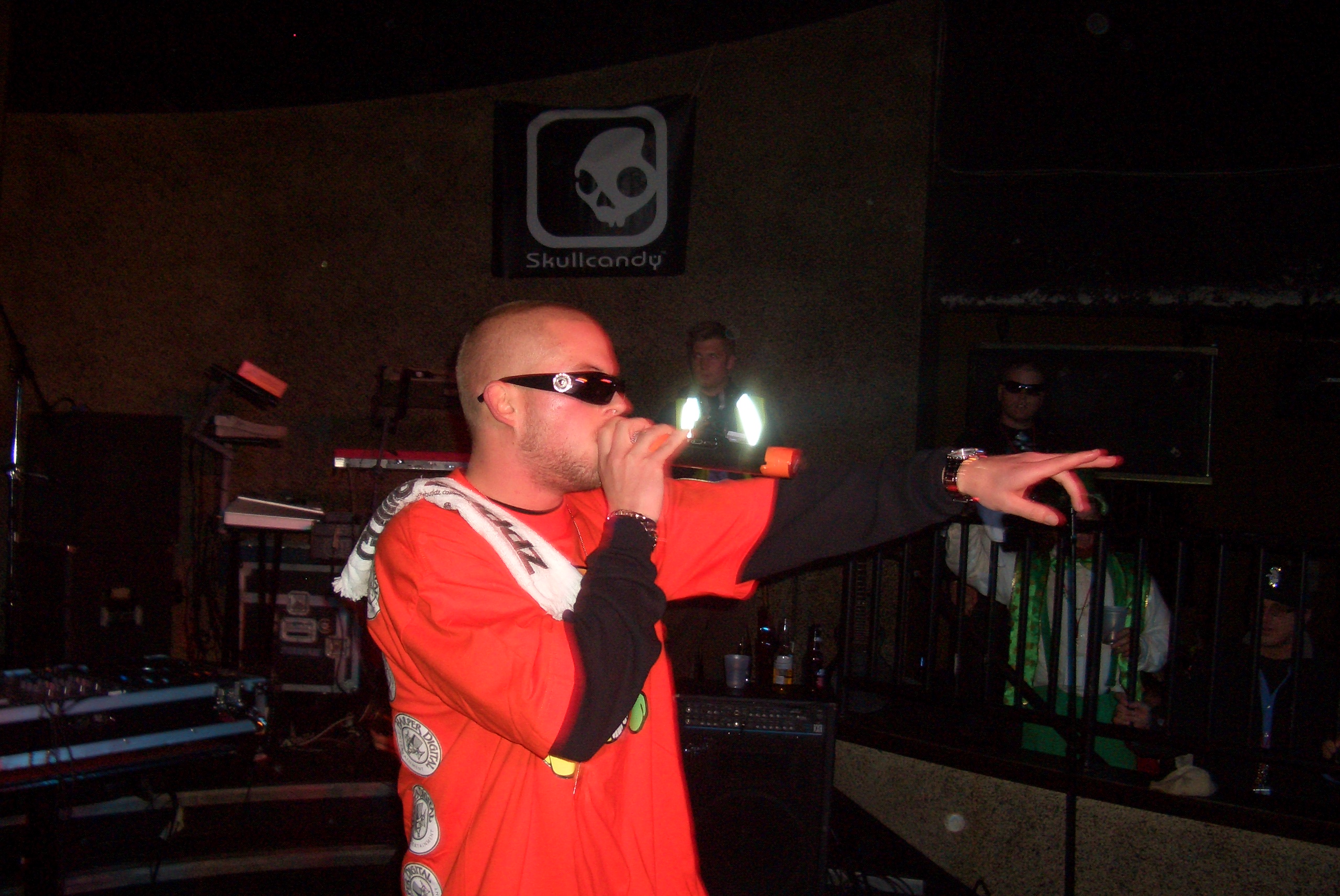
That was the overwhelming response I got from my friends in college. I had a beat up card board box sitting in the corner of my bedroom with 25 “skull crushers” and a square, black banner from SkullCandy.

“What are you going to do with them?” my friend asked as he was pointing to the box of headphones. “Give them away” I said. “I’m going to have the performers throw them into the crowd at the Halloween Party.”

My friend continued with the questions, “Really? Where did they come from?” I said, “The Consumer Electronics Show. This guy Rick started a headphone company. I couldn’t leave his booth. He had the sickest headphones with ridiculous designs and backpacks with built in speakers. Every design was so interesting and unique. I thought it would be awesome to give these away at the Halloween Party so I called them up and asked if they wanted to sponsor the party. They said yes.”

I’m pretty sure this was one of the first events they ever sponsored. The event was great and I sent them pictures as proof.

(above: picture of Collie Buddz in front of the SkullCandy banner at my Halloween event)

(above: picture of the DJ spinning in front of the SkullCandy banner at my Halloween event)


This was all a result of my 2003 trip to the Consumer Electronics Show in Las Vegas, the same year SkullCandy was founded. I met Rick Alden, John Lisichich, Brad Williams and a few other folks from SkullCandy while I was walking the exhibition hall. I don’t know the exact figures or size of the show off the top of my head, but suffice it to say, you could spend weeks walking the exhibition hall of that show and still not see every booth. And you would want to. As a tech junkie of gadgets and gizmos you could stay busy for hours looking at all the toys, but for some reason I couldn’t leave the SkullCandy booth once I stumbled upon it.

Apparently I wasn’t the only one either.

Fast forward to today. The company is now a publicly traded company and no matter where you go you’ll find SkullCandy product.

When I think about that box sitting in my room I often wonder about what they did so differently or what they did that made them so successful. After all, they were just selling headphones and in a business sense being in consumer electronics is typically a pretty hard business.

But the more I think about it, the more I realized their success came from great marketing and hustle. Rick and his team enthusiastically spoke to almost everyone that walked through their booth and they had a product they were proud to stand behind. It was a product they were excited about and a product mostly everyone else was excited about. It’s pretty easy to see how they would of had success getting their “skull crushers” into stores and moving them off the shelves. And now they are a global brand with product in almost every store.

It’s really exciting to see a small underdog grow up to be a leader in a space and its equally as gratifying to have have been a small part of the ride. I hope I see more success stories like this and hopefully one day I’ll have the opportunity to build a company like Rick did.

Now they are on to much bigger and better events than my tiny Halloween Party.

 (above: “Identity” concert I went to in Camden NJ on 8/19/2011 – DJ avicii is on stage)

Enhanced by Zemanta

What the hell is SkullCandy? Read More »

The University of Nothing – The Bylaws

I’ve said several times on this blog that the education system is broken and is in desperate need of change. I now think we are finally starting to see the emergence of a new era in education reform. One led by the private sector.

The issue I still struggle with is how to balance the intersection, or lack thereof, between cutting edge methods of education with societal expectations of having to graduate from an accredited university.

Specifically, what is the difference between a Harvard business professor teaching a Harvard class, in Harvard, vs. someone like a Fred Wilson teaching a business class in his firm’s office? What is the difference between a computer science professor teaching JavaScript in a university building vs. a computer science entrepreneur teaching JavaScript in some office space in NYC?

To me, the answer simply boils down to a piece of paper. A degree. Being able to say you graduated from a prestigious program or accredited university which is still very highly regarded within our society. My friend calls this a “luxury good.”

Furthermore, what does it really mean to have “accreditation in the United States?”  According to the US Department of Education:

The goal of accreditation is to ensure that education provided by institutions of higher education meets acceptable levels of quality.

Well I think its clear that the “levels of quality” are definitely not acceptable. Just go watch the movie Waiting for Superman.

And how exactly does a University even achieve this “accreditation?”

Accrediting agencies, which are private educational associations of regional or national scope, develop evaluation criteria and conduct peer evaluations to assess whether or not those criteria are met. Institutions and/or programs that request an agency’s evaluation and that meet an agency’s criteria are then “accredited” by that agency.

So I’ve always wondered, “what if there was a way to leverage the best technologies and platforms for education while still maintaining an element of prestige or recognition outside of the broken, very expensive university systems?”

And now I think I know the solution: New Accreditation Agencies and Guidelines.

Here is how it would work:

  1. There would be new, self governed accreditation agencies, with new guidelines, that are not subject to government oversight.
  2. These agencies would be comprised of successful, influential individuals who have rich domain expertise (e.g. venture capital, finance, online ad tech, biology, etc).
  3. The agency itself would be its own university or academic institution.
  4. These agency individuals would oversee: a) the appointment of other “teachers” b) the fundraising initiatives of the “investment pool” (described later) c) public outreach and communications about the agency itself via personal blogs, op-eds on third party publications, etc.
  5. These agency individuals would teach: a) design curriculums, b) teach and broadcast classes using the latest education platforms (e.g. SkillShare, YouTube), c) make introductions as needed on behalf of their students
  6. These individuals would invest: using the “investment pool,” these individuals would allocate money to students that have demonstrated the ability to succeed as a jobs creator, otherwise known as entrepreneurs via their class projects (described later).
  7. The investment pool would be comprised of capital raised from non-profits, endowments, donations and there would be no contingencies tied to the money.
  8. At the end of the curriculum, the students would be given a degree that is widely recognized by the participating members of the agency (e.g. the influential VCs, financiers, executives, etc). Instead of graduating in hopes of getting a job, these students would be graduating with an extensive network of active working people with a possibility of getting money from the “investment pool” to fund a business.
  9. Student tuition is not required.
  10. Tests are not used to assess students. Projects, prototypes, and inventions are.

Although fairly abstract and not fully vetted, I think the final result would be getting a bunch of smart people together, with money to help fund those smart people’s ideas, while providing the students with an umbrella of recognition, and a network of business contacts that could rival an accredited or prestigious university. All the while the students would be learning in the most efficient ways possible.

The best part is, the only people that would care to be involved in such a program would be those looking to build real businesses which in turn will drive innovation, new jobs, and real growth.

The University of Nothing – The Bylaws Read More »

The Productivity Paradox

When I was building Spinback as an independent company I would often work 16 hour days. These days were packed with meetings, work, planning, the whole 9 yards. I would come home at 1 am, 2 am, sometimes 3 or 4am. And you might think that after a long productive day the first thing I’d want to do would be to jump into bed and catch some much-needed z’s. Clearly a logical, sound thought. Work hard, go home, sleep. I definitely wanted to go to sleep to recharge and gear up for the next day, but that never turned out to be the case. I found that it was very hard for my mind to turn off and get the rest that I so desperately needed. But even with the lack of sleep, I still somehow had just as much energy the next day as I did the previous day.

In other scenarios and past jobs, I would often work 8 hour days. On many days work for me was slow so naturally I’d have a lot of time on my hands. You might think that having free time would imply that you could use that time to be creative. At the very least, you might think that by the time I got home, I’d have enough energy to start a new project, go to the gym or simply, do something productive. But it turned out that the less I did during the day the more mentally and physically exhausted I was. My brain was like mush. I felt useless.

I couldn’t explain it. It still doesn’t fully make sense to me, but after having this conversation with friends who are running their own businesses or who are really enjoying their work, it’s clear that I am not alone. They all experience this productivity paradox and they too recognize this weird imbalance of productivity and energy.

There is probably a number of reasons why this happens but when I try to make sense out of it I just recall this one quote from and old-time favorite – Shawshank Redemption (clip below):

You either gotta get busy living, or get busy dying.

I’m going to go with the “living” part of that quote. I might not get as much sleep but I think that’s ok. Hope you’ll do the same.

The Productivity Paradox Read More »

Honesty

Howard Stern television shows
Image via Wikipedia

I just finished reading a blog post by James Altucher titled “Do You Have to Be Rich to Be Honest?” Go read it. It is very refreshing and the theme of the post is probably the same reason why I read his blog every day. I think the theme of his post is also the reason why I am attracted to certain people, artists and musicians who deliver the same sense of raw, unfiltered honesty.

Jay Z, Nas, Bruce Springsteen, Billy Joel, Jon Stewart, Louis C.K, Howard Stern…

To me, these people represent raw clarity in their respective crafts. When you listen to Jay Z rap or listen to Howard Stern conduct an interview, you quickly realize how easy it is to get sucked up into their words. You can feel their honesty pour out and for that reason we are sucked in. At least I am and always have been.

And in a world where we are finally able to speak our minds to anyone and everyone with 140 characters, it is very easy to see how someone might be overly cautious or choosy with what they do, say or write. But after reading thousands of blog posts and listening to equally as many songs, I now see that the best pieces of work, and people, are always those that convey raw truth.

In fact, I think some of my more popular blog posts were written after having a few beers and not really giving a shit about how they turned out.

In closing, I hope that tomorrow you will strive to be a little more honest in your life and James lays out a great blue print for “How to exercise the honesty muscle.” I am by no means perfect, in fact far from it, but I’m at least going to try to be a little better and a little more honest.


Enhanced by Zemanta

Honesty Read More »

Value of Engineering to the Entrepreneur

This post originally appeared on Badger Engineers.

My company Spinback was recently acquired by Buddy Media, the largest Facebook Management Company in the world. It’s clear that my four years studying in the Wisconsin College of Engineering has played a role in that acquisition.

At the core, I’d argue that an engineering, math, or science related degree is the single best degree or use of four years in an undergraduate program, especially a program at UW – Madison. In my years in the COE, I obtained a certain skill set that has helped me succeed during and after school, and in the various businesses I was involved with including Spinback. I’m not talking about skills like designing a circuit or solving for a system of equations. I’m talking about the cliché skills we always hear about but disregard as obvious and too abstract for our own benefit.

The skills I’m talking about are teamwork, problem solving, hard work and creativity. In every single class and project that I worked on while at school, each one of these skills was required.  I remember spending many hours with my friends like Steve Weisman (ECE ’08) and David Nosbusch (ECE ’08) poring over class notes and textbooks (and also starting two businesses together while at school). No matter what the content and material, the routine was the same. We studied together, relentlessly discussed the problems together, and used creativity to help solve a solution when we couldn’t find one. In the COE, this is what we were all taught to do. In the real world, these are the skills that have helped me succeed and they are also the same skills that have given me confidence to venture out as an entrepreneur.

Before we were acquired, we were the typical startup. We had raised very little money and had a billion and one things to do. We had to build a product, sell the product to clients, create marketing materials, manage finances, create processes and business workflows, deal with attorneys, and on and on. The reality is I never learned about any one particular topic in school that was applicable to our business. Its not like I took a class called “how to prioritize features” or “how to get a terms sheet from a VC.” I did however learn how to think in a certain way. An analytical thought process that allowed me to break down each component of our business and understand how each component affected the other.  And this is what engineering is all about. It’s about understanding how things work, in order to identify a problem and ultimately solve for that problem.

At Spinback, the problem we were solving was how to help online retailers leverage social media to drive and track new sales. In a short period of time, our solutions called EasyShare and EasyTrack helped us secure over 15 clients in less than two months. We were able to sign up some of the largest online retailers in the world, convince investors to give us money to scale our business, and secure our position as a thought leader in the social commerce space. As a result, we were lucky and fortunate enough to be acquired by one of the fastest growing technology companies of all time.

Looking back, I can recall one very late night in our Union Square office. As we were trying to solidify a sales and marketing strategy one of my partners said, “this is one giant equation that we are solving.”  In that moment I thought about the four years at UW-Engineering and said, “Yes, yes it is.”

Enhanced by Zemanta

Value of Engineering to the Entrepreneur Read More »

Insane Maniac Business Partners

Starting a business is very hard and to be successful I think you need to have a certain set of characteristics, one of which I’ll call the “insane maniac” trait.

I by no means think you need to be certifiably crazy to start and run a business, but I do think you need to be able to handle the stresses of entrepreneurial life and to do so requires a mentality that, in some cases, you can just flat-out call crazy.

Things like:

  • Paying people with money you don’t have
  • Working 24+ hours straight
  • Flying across the world and back for one meeting
  • Buying assets with money you don’t have
  • Living with no income, but lots of expenses
  • Distributing flyers room by room, in hundreds of rooms for hours on end
  • Obsessing over a problem or idea during all hours of the day
  • Walking around for weeks with inventory in your backpack in hopes of making a sale to random people
  • Stocking boxes of inventory in your bedroom to the point you can’t move
  • Writing 50 page business plans at 3am
  • Diagraming an entire network of one’s business contacts
  • Selling something that doesn’t exist
  • Learning chinese to have one phone call
  • Learning how to write code from scratch to in order to build software

These are just a few things I’ve either experienced or witnessed firsthand by other entrepreneurs. So I think if you have partners you can trust, but can also operate at a borderline crazy yet obsessively steady pace, then I think you have a good foundation for building a business. And it will be with people that are crazy enough to make it work, whatever “it” is and whatever “it” takes.

I’m thankful to have been able to start businesses with people that fit this mould (even if only a little): Joe P, Lauren R, Steve W, Jesse S, Reese P, Dan S, Jeremy R, David N, Tom W, Corey C, Andrew F.

Enhanced by Zemanta

Insane Maniac Business Partners Read More »

Scroll to Top