Think

I had $2 million dollars in crypto locked on a wallet

Yes, I had $2 million dollars locked away on a crypto-hard wallet that I couldn’t access because of a forgotten password.

But let’s start from the beginning…

In 2013 I started to learn everything I could about the world of Bitcoin and cryptocurrency. It was clear that a new “internet of money” was being born.

I started reading, writing, buying, and experimenting with the world of Bitcoin and everything around it. I almost started a company with the premise of letting people more easily buy and sell Bitcoin. I’ll add that one to the woulda, coulda, shouda list.

As we now all know, a few years later the ecosystem started to pick up. More people were getting involved, including some of my friends. 

One of those friends had been making a living as a professional poker player. Instead of only trading cards and chips on digital poker tables, he now also started to trade various cryptocurrencies on a number of exchanges. 

I was however busy with my day job building startups and didn’t have time anymore to focus on the crypto world. But, I still wanted to get in early on some of the emerging, off-the-beaten-path technologies that most people hadn’t heard about yet.

So in 2018, my friend Jesse and I were chatting and decided we should make a larger, more concentrated bet on an alternative coin. I would transfer him the money and he would buy and hold the coins for us. 

And that’s exactly what we did.

On January 18, 2018, I sent my friend 2 BTC, which at the time was about $12,500/BTC. And with my 2 BTC, and his 2 BTC, together, we bought about $50,000 of a different coin called Theta at about $0.21 per token. This seemed a bit crazy at the time since the logical, sensible part of our brains told us we were basically lighting money on fire. 

This is what lighting money on fire looks like.

“Someone’s sitting in the shade today because someone planted a tree a long time ago” – Warren Buffet

That was my plan. 

To buy and hold, and not look at it for a very long time.

A few weeks go by…

We get a notice from the exchange where we had purchased and been storing our Theta coins. The exchange was about to shut down because the Chinese government was putting them out of business. Apparently, the Chinese government was working to ensure they had much more control over Bitcoin and the ecosystem. If we didn’t pull our coins and tokens out of the exchange by a certain date, we’d lose it all. I guess that’s China for you.

So we had to move the coins. We asked…

“Should we keep them?”

“Sell them?”

We decided to keep them. HODL!

Jesse bought a Trezor One hardware wallet and moved the coins onto the device for safekeeping. A hardware wallet is sort of like a digital lockbox for cryptocurrency, where the private information is stored within a physical electronic device. It looks a bit like a USB stick. We managed to move our coins mere minutes before the exchange disappeared.

Life went on. 


I forgot about the coins and really the rest of my crypto holdings for that matter and just got back to work on my business. 

And then…

Prices crashed. It was a nuclear winter in crypto land. 

My $25k was now probably worth a few pennies on the dollar and at that point in my life, I just didn’t want to deal with the emotional roller coaster of big swings in the crypto markets. I had enough on my mind with work and didn’t want to be distracted and stressed with these insane markets. I wanted to sell off all of my positions and just ignore the crypto world for a bit.

So I asked Jesse to transfer me my coins so I can sell them and be done with it.

“I can’t do that.”

I asked, “What do you mean you can’t do that? Just send them or sell them.”

And then he said something that would set us off on a wild adventure:

“I forgot the password!”

You see, this is remarkable for two reasons. First, Jesse remembers everything. He remembers all of our friend’s license plate numbers from high school. After all, he plays poker for a living playing 8 tables at a time, knowing the odds, and remembers how probably dozens of different players play the game. In fact, one of the first places we heard about Theta was from another poker player!

Secondly, if you guessed the password incorrectly too many times, the device self-destructs. I mean, it doesn’t actually blow up, but the entire contents erase and our coins would be lost forever! The good news however is if you forget the password, you can always restore the device using a recovery seed which is basically a 24-word passphrase. Jesse wrote this down on a piece of paper while originally setting up the Trezor, but it got thrown away by accident along the way.


We were screwed! 

At this point, I was almost relieved. After all, the investment basically went to zero and in many ways, it made living with that shitty investment decision a little bit easier to stomach.

I forgot about the coins and went on with my life again. 


Until…

The nuclear winter in crypto land was over. Prices started to go up again. 

Our $50k was back to about half.


Prices went up again….back to $50k. 

Now we figured we should really try to get this wallet open.

“Dan, you’re an electrical engineer. You can figure it out!” I should have paid more attention in class because there was no way I would figure this out. And even if I did, I had absolutely no time to even try.


At this point, I had convinced myself I would never see the money again so I ignored it.

Prices went up again!

$75k.. $100k…$200k!

At this point, we decided to get a bit more active to figure this out.  Jesse started googling the earth to find people that could help.


We found engineers that allegedly hacked this wallet before, but they weren’t interested in helping.

$400k!

We found a few engineers who seemed like they could pull it off but they either flaked, weren’t interested or ran into obstacles quickly. Some of those engineers were even engineering professors from my school.

$800k!

Finally, we found some guys in Switzerland who claimed they had done this before. They seemed like they could actually pull it off. The problem now was that I needed to meet them in Paris at their secret lab and Europe was shut down due to COVID. For a few weeks, we went back and forth trying to figure out how we could rendezvous in Europe to pass off the wallet but the combination of the shutdown and not being able to physically go to the lab to watch them hack the wallet made the prospects of this working a bit grim. 

A new update…

We see a press release about Theta:

Institutional investors Sierra Ventures, Heuristic Capital, Venture Reality Fund, and GFR Fund stake over $100M in Theta to a collective Enterprise Validator Node

$1.5mm!

We were back at square one.

Group chats with our friends were becoming ridiculous. I told Jesse if we couldn’t find a technical way to free the coins, we’d find a chemical way to free the coins. As in, we’d go away for a weekend and I’d feed him hallucinogens until he remembered the password. 

We found another engineer in Portland. He was a part of a famous hacker group back in the day and testified on the Senate floor saying, “Yes, we can take down the internet in 30 minutes.” We had been exchanging emails to see if he could be our guy to figure this out and free the coins.

He bought some hardware and special devices, made a few calls to some friends in the hacking world, and off he went, trying to hack an exact make and model of our Trezor to prove he could do this.
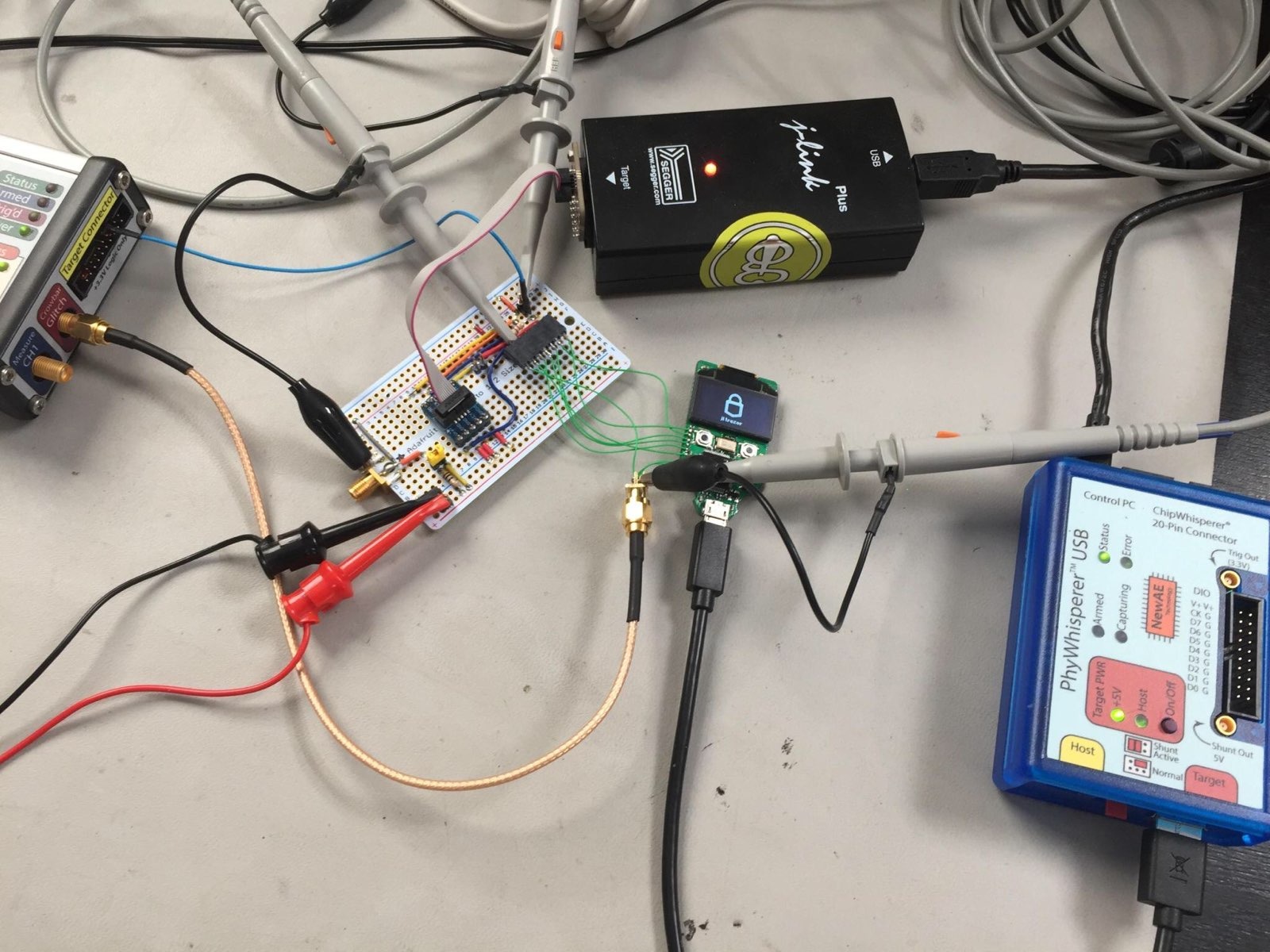
This is the solution Joe came up with to hack the Trezor wallet.

Over the next few weeks, he went to work and would update us on his progress.

$2.0mm!

I said as soon as he could prove success, I’d book a ticket out the next day to come to meet him in person with the wallet. We also talked about the fact that if he could actually pull this off, he could offer these services to many more people like us that are locked out of their wallets. In addition, we agreed that we’d have to film this hack because one way or the other we would have to tell this story. 

It would either be a triumphant story or a miserable and expensive story, but either way, we were going to document the whole thing.

And sure enough, I eventually get an email with something to the effect of…


“I did it!”

The next day, I drove to Jesse’s apartment, picked up the wallet, and booked my flight to Portland to meet the hacker, Joe Grand

The rest they say is history…

After two days in Portland, spending a few hours in his lab performing the attack on the wallet, he freed the coins!

At the time the wallet was officially hacked and unlocked, the total value of the wallet was about $2.5 million dollars. 

At the lowest point, it was about $20k. At the highest, it was just over $3 million.

Joe is now making his services available to anyone that is locked out of their wallets with a new company called offspec.io

Did we sell the coins? Yes, we sold some.

The rest? We put on another Trezor and locked it away.

And that’s my story about how I had $2mm locked on a crypto wallet.

And you can see the whole thing go down in this video.

And, The Verge wrote about it here too.

I had $2 million dollars in crypto locked on a wallet Read More »

How I Start My Day

Every morning I use a basic journaling routine to start my day.

When I fire up my computer, the first thing I do is open my note-taking tool and copy/paste in my daily template.

That template looks like this:

***

Today’s Date – November 30th, 2021

Gratitudes

  1. The first thing I’m grateful for today. This could be something small like..
  2. I’m grateful for this hot cup of coffee to start my day, or something bigger like..
  3. I’m grateful to be able to celebrate the holidays in-person with my friends and family after a lousy year with Covid-19. It doesn’t matter if it’s big or small. This routine just helps to build the gratitude muscle and grounds myself with positivity and healthy perspective to start the day.

To Do List

  • What’s the next action I need to do? I update that here
  • and here
  • and here
  • and sometimes, it adds to the to-do list from days before and reminds me that I need to get focused and burn down my to-do list. Sometimes I also realize I had to-dos that weren’t in fact important or just resolved themselves on their own.

Idea Of The Day

  • Is there any stroke of genius or ridiculous idea I want to write down and revisit later? If so, I’ll jot it down here.
  • Or maybe it’s some quote I heard or read, that just seems like a great idea to ponder and think about.

Notes

  • Throughout the day, I’ll just log my notes in this section. If I have a call, I’ll add a bullet point like…
  • Call with Batman to discuss the new Gotham City Building
    • And then I’ll add notes about that call here

***

I use Roam Research and templates to make it easy to link and group ideas together over time, but really any note-taking tool should work here. You can see a snapshot of that below. Another new one to look at is called Reflect App.

I’ve found this to be a pretty simple and effective way to start my day.

How I Start My Day Read More »

The Power of Perspective

This is one of my favorite times of the year.

When people start asking questions like, “what are you doing for New Years?” it brings into focus the fact that the year is almost over.

And then, inevitably, I think…..How did the year go? How do I feel about the year ahead?

Whenever I zoom out and ask those more macro questions…I keep zooming out…I think about my life and my work compared to other parts of life, to other people, and other situations…

I think about the homeless person living on the corner of 30th and park, a few feet away from our NYC office…

I think about my grandfather that had to drive 2 hours each way from southern New Jersey to New York City, seven days a week to sell eggs from his farm…just a few short years after fleeing the Holocaust and war in Europe…

I think about the headlines in the news…people losing their kids to gun violence…

I think about people being silenced and “disappeared” for sharing their thoughts publicly…

I think about the people that thought they’d have a wonderful morning out skiing with friends but don’t ever make it home…

At times it can be hard to see all that we are thankful for and to appreciate all of the good things happening in our lives. This can be especially hard when scrolling through Instagram, Facebook, or Twitter and comparing your life to the few glorious minutes someone spent perfecting their ‘gram’ and public display for the world.

Or it can feel depressing when reading posts on LinkedIn about how people are crushing it with record-breaking numbers, promotions, and everything in between.

We’re all guilty of this and it could lead us to some dark and interesting thought exercises.

I’ve been there. I get it.

But the reality is this…

Whatever you may be going through or feeling, just try to have the perspective that no matter the situation you’re in, things can likely be a lot worse.

The power of this perspective has been one of the most important and impactful mental models for me throughout my life.

Maybe it can be helpful to you too.

Happy thanksgiving.

The Power of Perspective Read More »

Tomorrow Will Be Better – Vote

On November 11th, 1947, on the heels of World War II, after the fabrics of government and society were torn to shreds in Europe, Winston S Churchill went on to say this:

‘Many forms of Government have been tried, and will be tried in this world of sin and woe. No one pretends that democracy is perfect or all-wise. Indeed it has been said that democracy is the worst form of Government except for all those other forms that have been tried from time to time.…’

Today is election day. As we know, things are far from perfect.

This can be said about most anything.

Our work and Business, our relationships, our finances, our health.

We all want to do better. We all strive for more.

Today, we have the fortunate opportunity to do more for the country that we live in. We are able to make our voices heard, and counted.

We get to vote, and decide who will represent us and help shape our country and the world for a better version of itself.

And in that effort or any effort to grow and improve, there will be pain, there will be stress, there will be disagreements, there will be failure.

Whatever happens today or this week, it’s important to remember that this perfect union called America is far from perfect, and frankly, it will never be. But as long as we keep putting in the work in our own way like voting, by creating new jobs and opportunities, by making our voices heard, by being decent, by being honest, by doing the right thing, and anything else that perpetuates ‘good’ and the values we hope to live by, we should rest assured that things will indeed get better, as tough as they may seem in the moment.

As a comparison, remember that just years ago the world was in a much worse place compared to today.

  • Political grievances were settled with gun duels
  • Mothers and fathers were sending their 18 year olds off to the beaches of Normandy
  • The average life expectancy from 1500s to 1800s was between ages 30 and 40 years old
  • Poverty, hunger and child labor are at the lowest levels they’ve ever been
  • Child mortality is the lowest it’s ever been
  • Homicide rates are the lowest they’ve ever been
  • More people in the world live in a democracy than ever before
  • The literacy rate in the world is the highest its ever been
  • Moore’s law, which describes the empirical regularity that the number of transistors on integrated circuits double every two years, is still tracking since inception in 1971
  • Access to the internet is increasing
  • Solar energy is the cheapest its ever been

By mostly all accounts, the world is in a much better place than it has ever been and I take solace in this fact.

But I also recognize that we must continue to play a role to maintain this forward progress.

So today, please take the time to vote and reflect on what more you can do, regardless of the outcome.

Whatever happens, I’m still the most optimistic I’ve ever been about what’s ahead.

Tomorrow Will Be Better – Vote Read More »

9/11/2020

Today is September 11th. Like many of you, I remember exactly where I was and how I felt the minute I saw the plane fly into the towers.

That sort of thing sticks with you for the rest of your life.

I know it has for me, and painfully, more-so for others.

In a blink of an eye, the world changed forever.

As we know, the world changed again this year in more ways than one.

Not a single American has been unaffected by COVID or the state of affairs, and like 9/11, some have been much more affected than others.

This has been a tough year.
It still is.

However..

Through it all, I’m reminded of how fortunate I am to be able to spend my days with incredible people in my life.

I recognize that this thing called life is a lottery ticket. It’s an opportunity that’s been stolen from many.
I plan to make the most of those opportunities….for me and for them.

#NeverForget is something we’ll all see on social media and it is true, we should never forget what happened that day.

But we should each take a moment to #NeverForget the opportunities we have and the position we are in. We are all, relatively speaking, very blessed and fortunate.

So in those moments of pain, despair, regret, frustration, sadness or anxiety, just never forget that you will get through it and come out stronger on the other side.

This year is far from over, but I’m the most excited and hopeful I’ve been in a while, despite the state of the world.

#NeverForget

9/11/2020 Read More »

My Daughter’s First Pediatrician

Sometimes you experience something in life that’s rocks your core and makes you take stock of the short time we have here.

Today was one of those days.

My wife and I took our almost 8 month old daughter to see a specialist. I say “almost 8” because at month 8, the doctor wouldn’t see her.

Our pediatrician told us that after month 8, it really doesn’t make sense to get your baby checked out for having “flat head syndrome.”

That’s what the check up was for…

We simply wanted to know if our daughter would grow to resemble her parents with decently shaped human heads or that of an alien.

In my case, maybe both!

We asked our pediatrician and he seemed to think it would be fine. After all, he’d seen countless babies over the years and had seen our daughter grow up since her very first day on earth.

He gave her the first check up, her first shots and vaccines, and so on.

He also shared with us a sort of “go with the flow” philosophy on parenting I could get on board with…and a “no TV policy” that was far less exciting.

“Her head is fine” he said.

“She’s perfectly healthy. But if you really want to get her checked out I have a good friend and specialist that you can see.”

A week goes by…

“Dan, our daughter is going to look like an alien!” my wife said.

I replied, “But aliens have big heads because their brains need the space.”

You can guess who won the debate.

So today we went to see the specialist.

“So what brings you here today?” said the specialist, Dr Peter.

“We are concerned our daughter’s head may becoming too deformed and could present some developmental issues. Our pediatrician said it probably wasn’t a big deal but we figured we’d come in anyway especially now that we think her head has gotten a little worse” said my wife.

He took a quick look and her head was fine.

He asked, “Who’s your pediatrician?”

“Dr. Cammerman”, my wife responded.

“O he’s great. He was my kids pediatrician their whole lives. They are teenagers now but they’ve been seeing him forever.”

As a new parent, it felt pretty great to know another doctor shared the same pediatrician as us. We told him how much we liked him and how great he was with our daughter.

“We saw him 3 weeks ago and will be going back soon for another check up.”

He asked, “you’re going to see who?”

“Dr. Cammerman,” I said.

And then another question….

“Umm…Daniel Cammerman?”

I said, “Yes, the same pediatrician your kids use. The one that sent us here.”

Silence….

“I don’t know how to tell you this but Dr. Cammerman died two weeks ago in a biking accident.”

More silence..

“He was riding from his home on the upper west side across Central Park to his office, he slipped on a patch of ice and was hit by a school bus.”

More silence…

He was only 50 years old with two kids.

But he really had more like hundreds if not thousands of kids over his career.

My daughter was one of them.

And now a good soul and good man is gone. In such a short period of time he imparted wisdom, kindness and care on me and my family.

I wish my daughter would have gotten to know him better.

I’m sure his family wishes for a lot more than that.

I do too.

I can only hope with time they appreciate and cherish the impact he’s made on so many children and families. His kindness and caring will stick with me forever and act as another reminder of how important it is to be kind and be in service of others, wherever and however we can. Life is too short to do otherwise.

He knew that and became a doctor.

He will be missed.

Please do something good today. Make a dent in the world in a positive way.


Article: Doctor riding bike through Central Park wipes out on ice, is fatally struck by school bus full of kids

My Daughter’s First Pediatrician Read More »

Decade Predictions and Pontifications

I’m late to this, but let’s do it anyway. Here are some predictions and pontifications for the next decade. Some I really believe and others not so much…although I wouldn’t be shocked if they happened.

Travel

  • Air drone taxies – we’ll be calling for on demand pick ups only we’ll get picked up and delivered by flying drones designed to transport humans short distances.
  • Commercial space travel – this is happening. I’ll be buying a ticket.

Energy 

  • Clean energy will represent one of the biggest opportunities and we’ll see companies take off that focus on carbon reduction, water sanitation, and solar energy.
  • Battery innovation will continue. Long TESLA
  • Nuclear energy will make a comeback
  • The energy grid will begin to decentralize. People will get tired of blackouts and intermitted service from their energy grids designed decades ago.  

US Politics 

  • The politics pendulum swings more violently back to the other side and then at some point the pendulum breaks. We’ll see more unrest as the wealth gap continues to increase, which also fuels continued and growing antisemitism and then at some point, a legitimate conflict here at home.
  • The space force completes its first media-worthy mission

Geo Politics

  • The middle east alliances shift and old enemies become allies
  • China officially becomes the global super power largely due to their government structure enabling them to play the long game, despite limiting freedoms among their citizens.

Money and economy

  • Trillionaires!
  • The ‘haves and haves not divide’ gets even bigger. This isn’t good.
  • Cryptocurrency becomes a legitimate and regulated means of monetary currency among some countries.

Education

  • The college business model blows up. Student debt is the next bubble, even after the debt obligations have been pushed out for longer payback periods. At some point, it just breaks.
  • The rise of “Influencer teachers.” Much like we see instagram influencers today make a lot of money promoting products, we’ll see “influencer teachers” doing precisely that: teaching. Only they’ll get paid for it because the millennial generation and their kids prefer to get the ‘right’, supplemental and cost effective tutoring and education for their kids.
  • Chemistry and biology > Computer Science because we need to fix the physical world. More jobs here, more students here. It becomes the new hot thing to study.
  • Genetics > Chemistry because we need to fix and alter people that can save the world. This is also more effective and cheaper medicine. This too becomes the new hot thing to study.

Medicine

  • CRISPR technology will commercialize and will disrupt the traditional pharmaceutical industries replacing the current chemistry-driven supply chain pharma and medicine companies. For example, instead of taking insulin for diabetes, you get your genes sliced up to never need insulin in the first place. A lot more money gets invested here.

Social and digital media

  • We see a new social network pop up that reminds us a lot like MySpace. A site that supports creative expression but does so in a way that feels messy. And people love it.
  • The oasis is here! See Ready Player One. In fact, this medium becomes ‘mainstream media’ with more users and eyeballs spending time in it either playing games together, watching shows together, gambling and more.

Ecomm & CPG

  • 100x the startup CPG brands that we see today because it becomes easier than ever to start an independent CPG brand with products and companies like Shopify making it dead simple to get up and running.

SaaS

  • We of course see more and more SaaS startups pop up, which also means we’ll need more ways to get those tools talking to one another to enable business to make sense of their information and customers.
  • Homogenization of business and customer data will become a priority for every company
  • Interacting with this information in an easy and human way will be more important than ever so we’ll see the increased adoption of conversational mediums for work whether voice enabled or more purely messaging mediums

Health and beauty

  • More clean products. Clean ingredients. Clean and reusable packaging.
  • Plant based everything

Investing

  • Startup investing looks more like public equity investing. We’ll have an NYSE or Nasdaq of sorts for private companies. 
  • More people can and will invest. Simply, we’ll see more angel investors.
  • Rise of the founder/investor incubator model where former operators don’t want to start just one company, but don’t want to only invest either. Instead, they want to leverage their operating background plus access to capital to get more shots on net within their own firm or incubation studio. More of these.

E-Sports

  • Biggest sport on earth as measured by viewers and liquidity through the ecosystem. 
  • Pro gamers are celebrities. We’ll know many, many more by first name. My parents included.

Religion

  • Much like scientology became a topic of discussion in the main stream zeitgeist, we’ll see another new religion of some kind pop up. It can and will likely be a scam or cult, but we’ll see it and hear about it.

That’s my list for now. It will be fun to revisit this at some point in the future. Surely I’ll be wrong but it’s great to get it on paper.

Decade Predictions and Pontifications Read More »

How Instagram Helped Him Quit His Job To Become A Full Time Artist

My favorite stories are all about hustle and Jeremy’s story is precisely that. In the fall of 2014, Jeremy Wolff quit his nine to five day job doing marketing and sales in the pharmaceutical industry. He did this while living in New York City of all places and took a huge leap of faith to pursue his dreams: being an artist.

I spoke with Jeremy to get his story of how he went from a corporate slave to becoming a full time artist, and flipping the term “starving artist” on it’s head by making many, thousands of dollars for his paintings and selling them to artists, celebrities and athletes.

screenshot-2017-03-01-21-37-48
Instagram “jwolffstudios: Getting there. Not too much left to do. Hope everyone has enjoyed the progress pictures. Also a nice glimpse at my work station.”


Dan Reich: What was the decision of quitting your job like?

Wolff: Quitting my job was probably the biggest and hardest decision I have ever made. It was not something I just did randomly one day. It was a thoughtful process and a decision I had thought about for years before actually doing so. It is my opinion that hundreds and thousands of people go through life never knowing exactly what they want to do with their career. They end up jumping from job to job, chasing that higher title and salary down a path through standard and monotonous corporate America. I often questioned what it was I wanted to end up doing. I knew I had a diverse and creative skill set, but I never was given an opportunity to show that at any of the jobs that I had during my corporate stint.

It wasn’t until I took a 10-day vacation on a trip to Israel for my birthright where I got to reflect on my career and think deeply about what I wanted my life to be. We were in a very artsy town and I had noticed a lot of street art and vendors selling their artwork for hundreds of dollars and I looked at my friends and said, “I can absolutely do that.” My friends looked at me like I was crazy at first but it was that day that I knew I was eventually going to give it a go.

Reich: What were some of the first steps you took to changing your career and becoming an artist?

Wolff: The first thing I thought about was whether it was realistic or not. I thought about my immediate network of family, friends, and past co-workers. I knew my strongest asset in the beginning would be word of mouth. In fact, I still think that is my strongest asset as I continue to grow and build my network. I have always prided myself as someone who never burns bridges. I have always made an effort to be the best I can at staying in touch with people. I figured if I could get one or two people from that core network to commission me for a painting in the beginning months it would be a great start. After all, I didn’t even have a portfolio of work to show off in order to gain any exposure. I knew I had to work diligently to have something to show in order to gain clients. Sure enough I did get a couple commissions from some friends and family and thus my art career had begun.

Reich: It must have been tough in the beginning not knowing when your next paycheck was going to come in. How did you manage to pay your bills?

Wolff: Tough is an understatement. It was always a grind. 20-hour days. Not all of those hours were spent doing tangible work, but more so brainstorming my next steps and figuring out my path. I knew I needed a way to make some quick cash any time I needed it. Gotta eat right? So, it was the beginning of September, nearing the end of the baseball season and September 25th, 2014 was Derek Jeter’s last home game. I thought this would be a great opportunity by doing a Derek Jeter portrait and having some prints made up to sell in front of the stadium. I painted an oil painting close up of Jeter taking an at bat, had 150 prints made, along with some business cards that featured the painting on it. I packed up the prints in a bag, borrowed my friends Jeter jersey, and stood out side Yankees Stadium selling prints from anywhere between 5 to 20 dollars each. Each time I sold a print I made sure to give the buyer a business card and told them I also work on commission. I ended up selling around 100 or so of those prints during that series and made right around $1200 cash. Not only that, but a dozen of those people that bought a print contacted me and commissioned me to do an original piece for them later on.

So I had figured out a way to make some quick cash while also getting my name out there. I continued with the New York sports theme for a little while and knew that whenever I needed some emergency money, I could go out to Madison Square Garden or Metlife Stadium to sell some Rangers or Giants prints. It was a large portion of my initial income when some would say I was a “starving artist”.

Reich: But you’re not starving anymore. I know social media has played a huge role in your success. Can you elaborate on your use of Instagram and other social media?

Wolff: There is so much to tell about social media so I will do my best to give everyone as much insight as I can. Instagram has changed my life and social media has given the term “over night success story” a new meaning. Instagram alone has over 600 million active monthly users. As a visual artist this was my obvious choice in terms of which outlet I focused most on. I told myself that I am not only an artist, but I must become an expert in social media as well. I consider Instagram half my job. In two years I have gained 16K followers and that number grows each and every day.

Reich: Tell us more about your Instagram activity. What are some tips you can give to other entrepreneurs?

Wolff: One great thing about social media is that everyone of importance is represented on social media and if they aren’t then they are way behind the eight ball. Because of that, it is so important to be as active as possible. The more activity you have the more you will align with the algorithm of Facebook/Instagram.

The first thing I recommend when it comes to Instagram is to have role models. There has got to be one person or business that you look at and say to yourself, “I want to be like that.” For me, there were several artists that I chose to use as role models for my career. I used well known artists like Alec Monopoly, Retna, King Saladeen, BK The Artist, Bradley Theodore, and Mr. Brainwash just to name a few. I made it a purpose of my life to study these individuals. What connections have they made? What people are they talking to? Not only that, but I have taken it further and gone out and met a lot of those artists and have become friends and acquaintances. I think it is fair to say that I have piggy backed off some of those artists success.

Every night before I go to sleep I will go to one of the aforementioned artists page, take their most recent photo and begin following the accounts that have liked the picture. I also unfollow accounts to maintain a comfortable followers ratio. Then I ‘like’ over 1000 random pictures using hashtags that align with what I am working on. I am sure many people are aware that there are plenty of computer robots that can do this automatically for you, and there are. You can pay for this service, but why pay to have something completely automated when you can do it yourself but smarter? I focus in on my target market. I am coming in contact with people who I know are already interested in art because I am finding them through other artist’s accounts. This gives me better odds that I will one day come in contact with one of there collectors who may be spending thousands of dollars and investing in emerging artists like myself.

Reich: Tell me more about the business side of art.

Wolff: I think I am learning it as I go. I think there is a whole side of the art world I haven’t even come close to divulging into yet. The gallery scene is something I have every intention of breaking into one day when the right opportunity comes along. One thing I do know is that it is changing. Artists are beginning to realize they don’t necessarily need the galleries. I like to think about Chance The Rapper and how he became who he was with out a record label. We have the tools to do everything on our own these days.

Reich: What are some of your best experiences so far on this journey?

Wolff: Oh wow, there are some pretty surreal moments, I can’t lie. That’s a tough question. I have met some of my child hood sports hero’s who have personally signed my original pieces. Kim Kardashian posted one of my paintings on her website, that was a wild morning. I got to live body paint a model during this past Art Basel in Miami. I have met some amazing people that inspire me to be great, people you wouldn’t normally get to meet. But, I think the best experiences are when I get to see people admiring my work. Putting smiles on faces from a painting is so powerful. Being able to inspire other people to chase their dream. Being able to spread a message through imagery that I created. It’s just a special feeling and one that is hard to describe.

screenshot-2017-03-01-21-44-41
Jeremy’s Art Basel Show with the Kim Kardashian painting

Reich: What do you have on your horizon?

Wolff: I have some really cool projects coming up. I am currently working on my “Cartoon Money Team” series, which as you know features a Forbes Magazine cover with “Cartoon’s Richest Characters”. I have around 12 ideas in which I am going to include the 5 characters I deemed to be the Money Team. So you can be on the look out for that theme to continue. I also have a few murals planned to happen in 2017 and have already begun working out details on painting my first exotic car during Art Basel week 2017 down in Miami.

Reich: Give one piece of advice to other entrepreneurs and artists.

Wolff: My one piece of advice is the cliché that Rome wasn’t built in one day. While it is possible to get a viral hit in today’s day and age, being an entrepreneur is about gaining a reputation and that seldom happens over night. Just as in the corporate world you need a resume to get a job, it works the same way for yourself. I look at my career as an artist and entrepreneur the same way I looked at it while I had the normal 9 to 5. I told myself I am at the entry level of being an artist and I need to work my way up. For some it happens quicker than others as it does with corporate jobs as well. But, you need to crawl before you walk and walk before you run. Take it step by step. Small goals first and make them bigger and bigger each year.

How Instagram Helped Him Quit His Job To Become A Full Time Artist Read More »

Future Of Work Predictions For The Year Ahead

This post originally appeared on Forbes.

We’re unofficially past the “Happy New Year” stage of 2017; that new year smell has almost entirely worn off, people are back from their sunny vacations in the Caribbean, and many are hard at work.

A lot of enterprise tech trends have been predicted to establish themselves this year, but none is as buzzy as artificial intelligence. It has been on the horizon for some time, but 2017 is poised to be the first time that bots at work are natural parts of our everyday workflow.

Don’t be mistaken, AI has a ways to go, and could accelerate at an unpredictable pace as bots gather more data. But people’s hesitancy about committing to bots at work, and questions around the effectiveness of these tools, will gradually melt away.

With this theme in mind, let’s take a look at what some B2B leaders predict for the future of work in 2017:

Matthew King, Customer Engagement Consultant at Microsoft
“Artificial intelligence breakthroughs are occurring at a rate which will certainly result in significant swaths of both blue and white collar workers across the globe facing the risk of automation. Even professions like sales, which tout the importance of human-to-human connection, are facing the prospect of first being assisted by, and eventually completely replaced by machine intelligence. As a society we must fundamentally re-imagine what work means to us, what our purpose on this planet is, and how to provide for people in an increasingly stratified world. The gains of efficiency improvements mean greater profits for the owners of capital and greater poverty for those who lose their ability to trade labor and skills for wages. We owe it to ourselves to think through how we should adapt as individuals and as a society to the ascendance of hyper-efficient, hyper-intelligent machines.”

Dennis R. Mortensen, CEO and Founder of x.ai
“We will see less hype around virtual personal assistants in 2017, but also, and this is the important part, less stigma! People will begin to get a sense of the real world applications of intelligent agents and the AI that powers them. Given these agents will look and feel mundane compared to the AI’s and robots depicted by Hollywood, we’ll see fewer silly and cartoonish accounts of robots taking over the world and eliminating humanity.”

Ceci Stallsmith, Platform Marketing at Slack
“You’ll have a small army of bots to help you do your job. As businesses move from email to messaging, all of the software you use for work will connect with the most pervasive for-work messaging products. As every business and startup went mobile in 2011, bots are the next major trend. As Mailbox, Sunrise Calendar, and other mobile-first productivity apps rose up, there will be a trend in hot bot for-work companies rising up in 2017. The big question lies in how intelligent these little helpers need to be: do bots need to understand your every request? Will they be able to intelligently gather your needs, or will we be happy with their existence to fulfill a specific function? If intelligence is required for success, the major players—Google, Microsoft, IBM, and Facebook—have a significant advantage over smaller developers.”

Aaref Hilaly, Partner at Sequoia Capital
“It becomes normal to talk to computers at work. Natural language understanding catches up with image recognition. Home devices like Amazon Echo and Google Home train people on how they can interact. Application vendors start to build in voice and messaging interfaces into their products, leveraging research from Google, Microsoft and others.”

Andrew Berger, Head of Sales Development, Square
“Customers and buyers demand information at their fingertips, and technology is facilitating the speed of information. Collaboration across multiple teams, departments, offices, and organizations is much more efficient with streamlined communication tools, such as Slack, enabling rapid response and answers to customers. The ability to sync CRM data into these communication tools, with smart bots and agents facilitating the workflow in an automated fashion, ensures all stakeholders are aware of customer needs and provides a much-improved customer experience.”

Jake Schwartz, CEO and Co-Founder at General Assembly
“Just as with the telegraph, the telephone, the mainframe, the database, the fax machine, email, and the PDA, etc etc, there are always new technologies changing how we work. The deeper change is what that work will look like. The demand for people with skills in data, software development, UX, is growing at an accelerated rate YoY. This acceleration will continue as companies make their transition to the future, which will involve a constantly evolving set of trends around communication, automation, and the pace of change. In the year ahead we are seeing more companies face their own challenges around staffing these roles, and how to upskill their previous generations of workers. Here at GA, we’re trying to make an impact by enabling the sourcing and the training of this next generation of skilled talent.

There were more than 250,000 positions open last year for what are called hybrid technical roles. These jobs don’t only pay well – with annual salaries ranging from $65k-110k – but their required skillsets are actually trainable and do not require an advanced degree. Roles are growing in skillsets that don’t exist (or are just starting to) and there’s a limited talent pool from which to fill that seat. I think in the year ahead we’ll see challenges tied to that skills gap become a painfully obvious opportunity for non-degree programs to make an even larger impact. Here at GA, we’re trying to make an impact by training people to be the producers of the future. We’re working to create efficient programs that fill the need for people versus solely focusing on the need for jobs.”

Ray Carroll, VP Sales at Engagio
“In 2017, the industry will start to realize that Account Based Marketing is NOT a technology category, it’s a strategic business initiative. Just like demand gen and inbound marketing are ways of running your marketing machine, ABM is a way of running your revenue machine. And, just like demand gen, ABM breaks down into many categories – including account selection, account research, account-based analytics, account-based advertising, automated sales plays, and more. If you want to succeed in 2017, you must align your entire organization around this strategy, put the foundation in place with lead-to-account matching and account-based analytics, and focus on quality engagement with your target accounts.”

There will always be a fine line between AI that enhances our skill versus replaces us entirely, and unfortunately, some of us will wake up and find ourselves in the latter situation.

These questions will only begun to be answered in the year ahead, but in 2017 we will continue the march towards another step forward in automation and intelligent systems.

Disclosure: Slack is an investor in Troops.ai

Future Of Work Predictions For The Year Ahead Read More »

Retooling AI For The Workplace

This post originally appeared on TechCrunch.

One of the first computers required punch cards. I repeat, punch cards. Yes, you would take a piece of paper with tiny holes and use it to interact with the device.

Now we have computers the size of soda cans that sit in your house and control your lights, provide weather updates, solve math equations and tell jokes, all by simply speaking to them… and some of them have better jokes than my actual friends.

In many ways, we all should have seen this coming — we can thank our Hollywood friends for that.

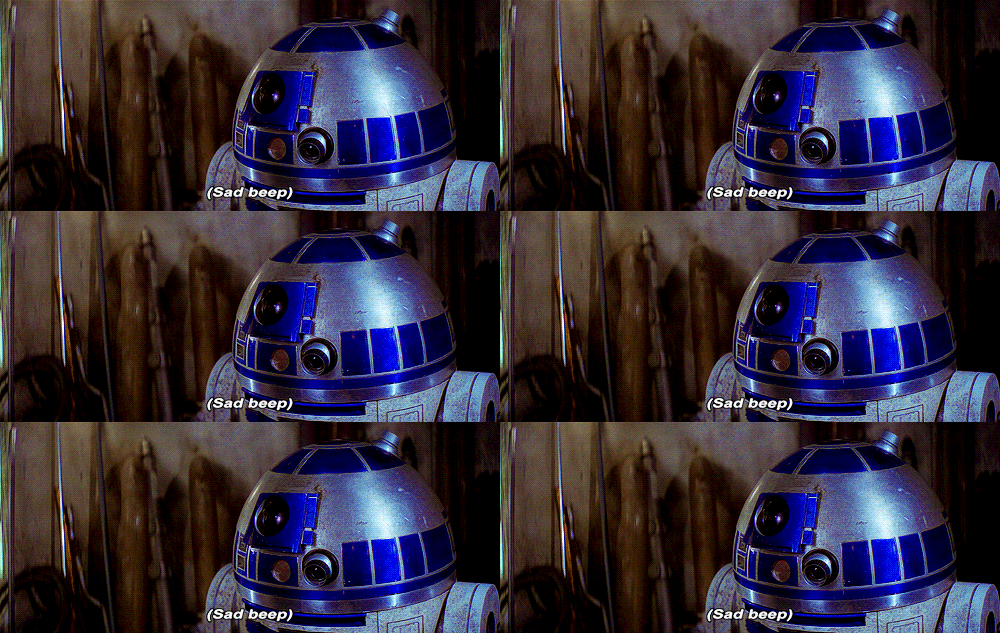
We had C-3PO and R2-D2 running around the galaxy with Luke trying to help him save the universe from his dad.

“Artoo says that the chances of survival are 725 to 1. Actually Artoo has been known to make mistakes… from time to time… Oh dear…”

giphy r2d2

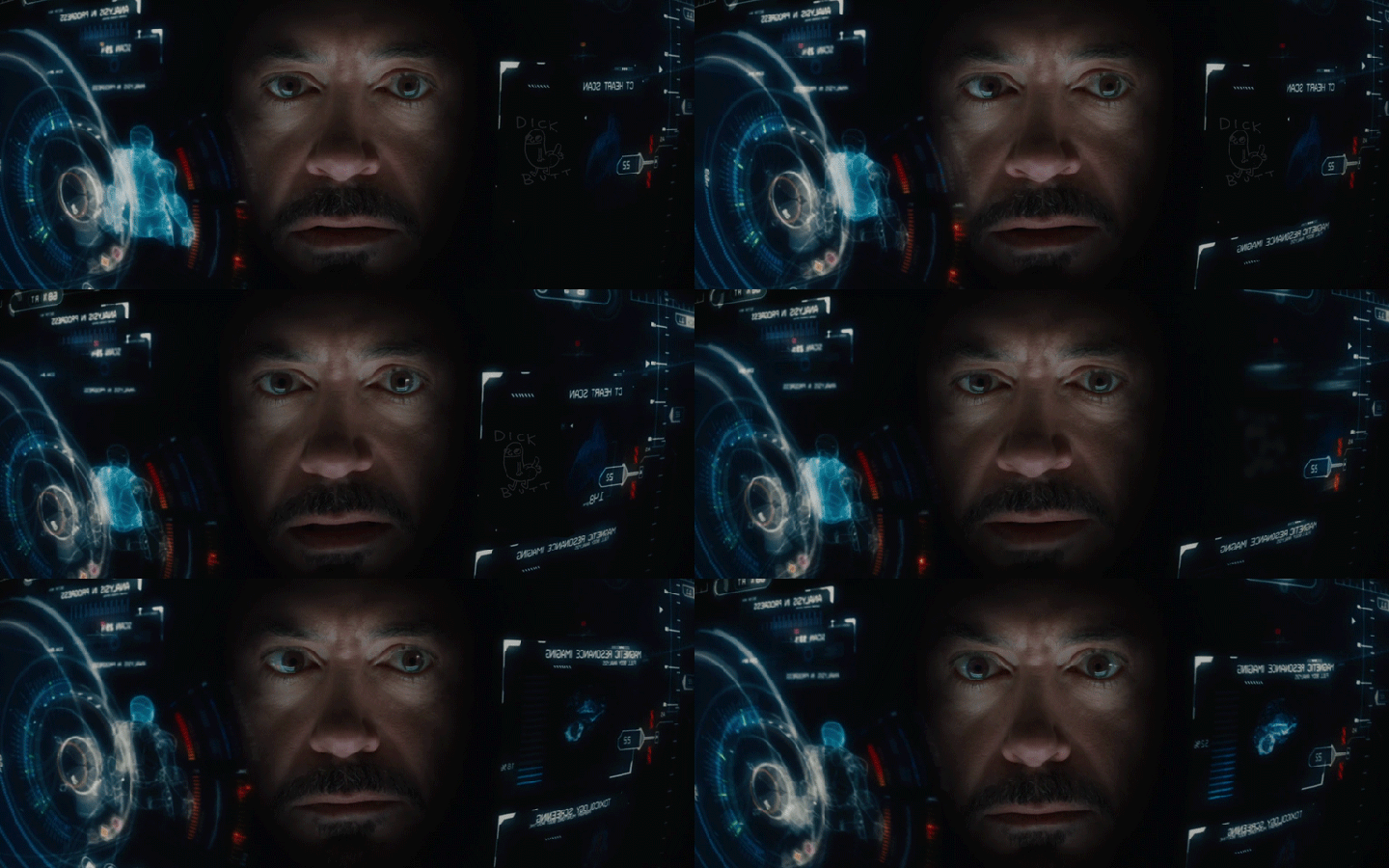
More recently, we’ve had others as full-fledged assistants that are smarter than most humans, like TARS from Interstellar and Jarvis from Iron Man.

As you’re reading this, you’re probably doing some kind of work. It’s a thing we spend one-third of our lives doing, after all. (Sleep and Netflix supposedly make up the other two-thirds.)

Given the massive chunk of our lives spent at work, shouldn’t we enjoy the tools we need to use for our jobs? Shouldn’t they feel more human and delightful, like Amazon’s Alexa or some of the other consumer-facing applications we rely on daily?

I think so.

And how much more effective and productive could you be if you had something like TARS or Jarvis helping you with your job?

I think the answer is… a lot!

How do we get there?

Many of the consumer-facing AI solutions we see today are built on the backs of generic APIs.

Let’s take something like Siri, for example. If you wanted to know the weather, you would simply ask: “Siri, what’s the weather?”

Siri could then transcribe your question and reach out to weather.com or another weather service for the answer using your location as a proxy.

Based on the answer, you’d have the immediate information you need to determine whether you should take an umbrella to work or not.

However, introducing a similar, frictionless AI assistant in the enterprise is a bit more challenging. Things are a bit more complex because each organization uses varying degrees of tools and workflows to run their business.

Borrowing from the weather example above, let’s say you wanted to know how much revenue was booked for the business in the first quarter. You might ask: “Siri, how much revenue did we book in Q1?”

If this “Siri for work” existed, it might give you an answer along the lines of “$100mm.”

From here you might want to drill deeper into revenue generated from each product line. If you were the Chief Revenue Officer of Microsoft, you might want to know how that revenue breaks out between Office 365, Windows and Xbox… and you might want the answer to be in top-line revenue because that’s how you like looking at the forecast.

Shouldn’t we enjoy the tools we need to use for our jobs?
Do you see how nuanced this can become? As we start to account for organizational preferences, things get complicated very quickly.

It’s easy to see how replicating “Siri for work” is a much heavier problem to solve because of the variance amongst organizational processes, systems and preferences. For consumer applications, there isn’t nearly as much divergence in the answers users expect (see above); this does not hold true for businesses.

This same issue applies in the context of scheduling. There are companies like x.ai and Clara Labs trying to take the simplicity of Alexa or Siri and apply it to the tedious task of scheduling meetings.

It’s one thing to say: “Siri, book me a meeting with Jon for some time next week.”

But all of a sudden you realize there are a handful of non-trivial variables this “scheduling Siri” would need to take into account. Things like the location of the meeting, preferences of the person taking the meeting, the availability and coordination of both parties instead of just one and so on.

And let’s take one more vertical application similar to “Jarvis for Work.” Within the legal industry, an AI-powered lawyer called ROSS has emerged. Firms can ask ROSS questions like they would their colleagues on important data, like citation resources, and it returns an answer. Their secret sauce is based on using natural language processing (NLP) to query publicly available law documents.

But can ROSS adopt to the style of the firm and specificity of a given case? Maybe some firms have found that very recent court rulings tend to be the best support, while others rank searches based on credibility and prominence.

In all the instances, there is nuance, which means some level of unique configuration and intelligence is required. This should comfort those fearful of waking up one day and having their job completely replaced by a robot. More realistically, the robot will allow them to be 10x more productive and allocate more time to higher-leverage tasks.

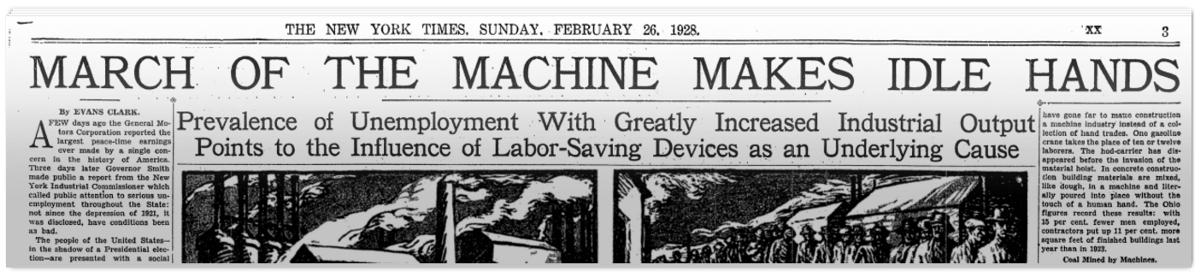
We’ve seen this story before; each time we experience new technological breakthroughs, we learn that people’s jobs are changed but not altogether replaced.

From a 1928 issue of The New York Times:

March of The Machines 1928

Different, yet the same

In all these different instances, the end result and goal for a user remains the same.

A perfect “Siri for work” would help reduce complexity and guide the end user to more quickly arrive at the information they need to make a decision or take an action. In the enterprise, even slight improvements can mean huge revenue increases and significant cost savings.

But, let’s take it a step further and explore how this artificially intelligent assistant at work evolves and becomes more intelligent over time.

The previous example highlighted the ability to look up information. What about having the AI suggest and take actions for you?

As we start to account for organizational preferences, things get complicated very quickly.

Say the VP of Sales at Microsoft needs to forecast her revenue for the quarter. We’ll call her Samantha. To do that, Samantha would need to have accurate close dates of when she thinks her deals will close. In this hypothetical example, she has five deals that are supposed to close in one week, but the AI knows there has been no communication with those accounts for more than four months because it understands your email, social media and phone communications.

Is it likely those deals will close? Probably not.

Therefore, the AI would know to automatically change the close dates for forecasting purposes, or make a suggestion like, “Hey Samantha, I noticed a discrepancy between your sales activity and your proposed close dates. Would you like me to change the close date for you?”

Voilà. The dates are closed and Samantha doesn’t look like a slouch at the next forecast meeting.

It’s easy to see how facilitating this level of workflow is entirely too complex for an out-of-the-box plug-and-play solution like Amazon’s Echo or Apple’s Siri. It requires a greater degree of configuration that is specific to the organization and which becomes smarter over time based on user input and data.

To facilitate this there needs to be a middle layer or conversational run-time between the various systems and data sets in an organization so an end user can quickly and easily do their job without having to open a new app or piece of software.

As Satya Nadella, CEO of Microsoft puts it: “In software development terms A.I. is becoming a third ‘run time ’— the next platform.”

I couldn’t agree more.

Toward the future

So what does this all mean?

The next frontier of software development and technological breakthrough will happen in a conversational run-time. I call it “conversational CRM.” It is the inevitable evolution of the technology stack for the enterprise.

This next era will occur on top of conversational interfaces because it is where work is already getting done and everyone already knows how to use them. This is why we are building on messaging platforms like Slack, which will serve as the conduit to facilitate enhanced intelligence at work.

Moreover, there will be even more companies, big and small, that crop up to help power some of the underlying technology that makes this intelligence and conversational workflow happen.

For example, Google recently unveiled TensorFlow, which is an “open source software library for numerical computation using data flow graphs.” To break that down in English, this sort of technology enables computers to do computations that more closely mirror the way human brains think and make decisions. Some people call this “deep neural networks.”

There’s also IBM Watson, which provided the backbone for ROSS mentioned above.

Within the realm of smaller startups, you have companies like API.ai and Wit.ai, which was recently acquired by Facebook, that have built a simple natural language processing API that helps developers turn speech and text into actionable data. This sort of technology will help bring that “Siri-like” experience to many other applications and experiences.

So as computers continue to shrink, and eventually shift from robots the size of soda cans to no interface at all, the next area of innovation will live in the messaging context (voice, text, email). Interactions between humans and machines will occur in the same place, side by side, all working toward a common goal of driving businesses forward.

The lines will get blurry, and, just like the movies, we, too, will have our own R2-D2 or Jarvis at work — no matter where “work” may be.

There was once a vision to put a personal computer in every home. Many companies today have a similar vision, which is putting a personal AI assistant for work in everyone’s hands. Think of it as a “Jarvis for Work” of sorts, except Jarvis will have cousins that each specialize in their own, unique vertical.

jarvisgiph

Retooling AI For The Workplace Read More »

Scroll to Top