Think

When it comes to Online Advertising, Keep It Simple Stupid

When things get so complicated the best thing you can do is go back to the basics.

In today’s world of online advertising, the “basics” are changing so it’s important to understand what those changes are and how they affect a marketer’s business.

I wrote a piece that was featured in today’s iMedia Connection that discusses this very point.

Excerpt from the article:

We are at the cusp of a new age of online advertising. As news ways of thinking about the ecosystem emerge, so too are there new ways for advertising campaign deployment. Math now seems as equally important as creativity. Technology now seems as important as artistic ability. This evolving trend has spawned new companies and has required older companies to change their very DNA, and with that, their name or classification.

The entire piece is here.

Things used to be much simpler…

Reblog this post [with Zemanta]

When it comes to Online Advertising, Keep It Simple Stupid Read More »

Shaun White is Crazy Committed to Gold

Two years ago I was volunteering on ski patrol at the Winter Dew Tour at Mount Snow, Vermont.

I was stationed at the top of the super pipe for the men’s half-pipe competition, but my shift was for the practice session. There were a handful of competitors and they were all mostly between the ages of 15-30. One of those competitors happened to be Shaun White.

I remember sitting there thinking, “Damn, these guys just snowboard all day, every day, for a living and soak up all the media attention during events.”

Then I saw Shaun White walk up to the top of the pipe. I remember thinking, “this dude is going to crank on some tunes, have a couple of red bulls, BS with the cute mount snow employees and tear up the half-pipe with ease….”

But when he got to the top, I quickly realized I was wrong, mostly.

Once at the top, he simply sat down in a chair (barely making any hellos), strapped on his board, and dropped in the pipe for one of the most ridiculous run’s I’ve ever seen live.

When he finished that run, he came back up to the top and did the same thing. Said almost nothing to anyone and dropped in for a second run. He did this maybe 2 more times after that.

Meanwhile, all the other competitors were goofing around, talking to the fans and soaking up the media attention.

Well, this week Shaun White won a repeat Olympic Gold Medal in Vancouver and I imagine he did it with the same style I saw at the Dew Tour.

Total concentration.

No BS.

No Games.

Dead committed to be the very best at what he does.

Props to Shaun.

Reblog this post [with Zemanta]

Shaun White is Crazy Committed to Gold Read More »

I made $99,620.00 Yesterday Playing Poker

Well, not really. But this guy did.

I’ve been playing poker for quite some time now and what I used to consider a “gambling” game, I now consider a game of math, game theory, strategic thinking, science, risk assessment, and money management. I’m not the only one. In fact, there is an entire society called the Global Poker Strategic Thinking Society that was founded on this very theory.

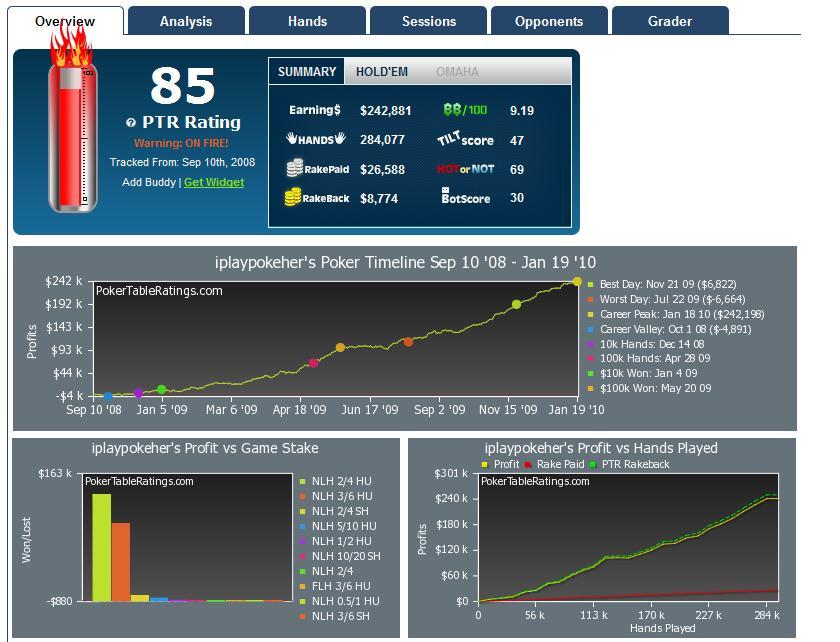
Jesse Linker, who is one of my good friends and is someone I have known for a very long time,  has been playing online poker as a full time job for the past 2 years. The fact that he has been playing poker full time is not what is amazing. What’s amazing is, if you look at his earnings over time (see image below), you’d notice a steady increase. No real losses. All consistent earnings. Key word here being: consistent.

In shedding some more light on this topic, Jesse agreed to share some of his secrets below by answering some questions. He is also the first person to be featured in a new series of posts called Student Profiles.” These posts will profile individuals who are consistently looking to learn and get better at what they do. Jesse no doubt fills that profile.

Student Bio – Jesse Linker
Jesse Linker is currently 24 years old and graduated from the from University of Maryland in January of 2009 with a degree in Finance. Since graduating, Jesse has been playing poker professionally. He has tentative plans of attending law school and if asked, he would say his biggest accomplishment is being from the same hometown as The Situation (Manalapan, NJ.)

Dan Reich: How long have you been playing poker for?
Jesse Linker: I’m not exactly sure when I first started, but it was somewhere around 13 or so. I first played online when I deposited $50 into an online poker account almost exactly on my 18th birthday. One of my other good friends made close to $1500 in one night, which he used to pay for spring break. I remember thinking how incredible it would be to play a game that paid so well, and was hooked.

DR: How many hours per week do you play?
JL: It varies a lot, but on average it’s probably close to 35 hours a week of actually playing.

DR: Do you consider poker to be “gambling?” Why or why not?
JL: In the sense that nearly everything you do is “gambling” when your actions do not guarantee an outcome. As the financial recession has shown, there is huge risk inherent to investing. In poker you are immune to a much larger degree of variables, whereas in typical investing, you are exposed to the macroeconomic effects of the global economy and global events. Even taking a job in a large corporation which has traditionally been seen as a “safer” leaves you with little control. I engage in a zero-sum activity, where my income is directly tied into my work ethic and improvement, something that very few other jobs can offer.

DR: Is there a difference between playing poker in person and playing poker online?
JL: There is, but I rarely play in person so I’m not the most qualified to highlight the differences. In general I do not like casinos so I would much rather sit on my couch with a laptop.

DR: How do you minimize risk and maximize income?
JL: After I graduated in January of ’09 I began to exclusively play heads up (1 on 1). I used to play 10-12 tables at once of 6-max tables and would inevitably get sick of that grind and stop playing because I did not enjoy it. In heads up I can play 1-3 tables at a time and I do not burn out to the same degree.

There is so much information available, that it makes it easier to effectively minimize risk while not effecting your income to a large degree. There are websites that track players results, with relatively detailed information. The results are not exact, but they give you a good idea so even before I start playing a person I know the limits they usually play and how they do at those limits. In addition there is software that logs every hand I play on my laptop so I will have information on people I have previously played, which helps.

DR: Do you have a “secret sauce” for showing such steady growth in the amount you’ve made?
JL: I think a lot of people play as high as they can as long as they think they have an edge. It sounds weird but even though I just turned 24, I am old compared to a lot of successful internet players. At 18 or 19 I think it’s easier to take more risks, and I definitely did. Now with most my friends working and the economic recession, I have a greater appreciation for the opportunity that poker affords me. Personally, I have found a good balance where I can make an amount I am satisfied with without taking risks and experiencing downswings I am uncomfortable with.

DR: Do you use analytics tools to monitor your performance? Does it inform the way you play?
JL: Not really, playing heads up allows you to closely pay attention to an opponent’s tendencies and then tailoring a strategy that you think is most effective. I like to have basic information in order to have some ideas on how they play but past that I do not really use any. When playing 10-12 tables this was close to impossible, and your play is more robotic.

DR: Do emotions ever affect the way you play? Have you ever lost money because you were angry or upset?
JL: Of course, and its something that even the most successful players in the world are not immune to. You try to minimize how much it effects you, but pretending that emotions never affect you is probably more detrimental than acknowledging that they always will.

DR: What advice would you give to people that are currently playing, or are thinking about playing poker online?
JL: I think its considerably tougher now than it was a couple years ago to build up a bankroll. There are so many training sites out there such as cardrunners.com that have made it exponentially easier to improve and become competent. I think if you are intelligent enough to start poker today and become successful you are probably better off focusing your energies somewhere else.

For people currently playing I would say the most important piece of advice is to be critical of yourself. There is a lot of information to process, and even when you make the best decisions possible you will often get a negative result. Its easier to blame things out of your control, such as luck rather than realize that even if you were unlucky you should concentrate on your actions and what you can do to improve. In the same vein, when people make a poor decision sometimes they are rewarded and again they are not critical of the actions they control.

This is why poker will always be profitable because it is a flaw universal that people by in large are far too results oriented. An NFL coach who goes for it on a risky fourth down play is largely judged on the outcome of the play, regardless of how correct or incorrect the decision was. Investors are similarly affected with the outcome being the source of criticism or praise rather than the soundness of the decision. Most decisions have a myriad of outcomes that are out of your control and all you can do is make the best one with the available information. Being too concerned with results makes it impossible to best focus on improving your decision-making.

(Snapshot Below: One of Jesse’s online poker profiles)
Reblog this post [with Zemanta]

I made $99,620.00 Yesterday Playing Poker Read More »

Negotiation Tactic #1 – Pretend Like You Never Heard Their Offer

This is a conversation I recently had with a NYC taxi driver, for the most part.

Because negotiating is just fun sometimes…

Me: Hey Taxi Driver. How much to go to Jersey City?

Taxi Driver: (thinking about it…) $50.

Me: Awesome, $25 is perfect. Let’s go.

Taxi Driver: What? I said $50. There is a toll and it is out-of-state….(hesitation… as I begin to back away from the taxi)…ok fine, $45.

Me: Ok, $25. Let’s do it. After all, it’s the same distance to Brooklyn and that fare only costs $18 dollars, so you are getting a sweet deal here.

Taxi Driver: No, not $25. $45….(hesitation..as I once more begin to back away from the taxi)…ok fine, get in, get in…$40.

Me: (I get in the cab thinking $10 discount off his original price wasn’t so bad. But I still wasn’t done…) Good deal man.You are a good businessman. You’re going to make $7 more for going the same distance you would normally go for a fare to Brooklyn. You are a smart dude. If you could only get $25 every time for this ride you’d be making some good extra coin. You’d be going the same distance to Brooklyn but instead of $18, you’d be making $7 more for the same time and effort.

Taxi Driver: No, I can’t do $25.

Me: Ok, pull over here and let me out.

Taxi Driver: Ok, ok, fine…$35..(he gives me a good explanation and I decide to flex on price a little bit..mostly because the guy seemed like a good guy…but I still wasn’t done..)

Me: Ok fine, $30. You win. You really are a smart businessman.

Taxi Driver: No, no..$35 my friend.

Me: Ok, that is better, but we are almost there. If we can do $30 then you have a deal. If you could give up $5 more than you’d be making $12 more instead of $7 for the same fare that it would cost to go to Brooklyn. Actually, if you did that, you’d probably be the smartest taxi cab driver ever.

Taxi Driver: Ok, fine $30.

Me: See, you are a really good businessman.

And after all that…I ended up tipping the guy back to $40 anyway because he seemed like a good guy.

M0ney Management Tactic #1 – Don’t give back the money you just saved from Negotiation Tactic #1.

Reblog this post [with Zemanta]

Negotiation Tactic #1 – Pretend Like You Never Heard Their Offer Read More »

The “Do Whatever the F you Want” Decade – Past 10 Years in Review

After spending some time away from the computer over the past two weeks, I finally got some time to think back on the past 10 years and here’s what I’ve got.

The past 10 years have really just been about instant gratification. It has been the “I want it, and I want it now” mindset, thanks to a whole variety of toys (ie. Google, MySpace, AIM, Xbox, YouPorn, PartyPoker, iPhone, Investment Banks, TIVO, among many other things).

Looking back on the decade, here are a few things that really stood out in my mind as “game changers.”

  • Google – Obviously. I remember having to call 411 for information.
  • Call of Duty, Xbox Live, US Airforce, and Blizzard Entertainment – We used hover around Nintendo 64 in order to play Mario Cart and shoot each other with turtle shells. Then there was the emergence of Blizzard’s first online multi player forum which really set the stage for online gaming.  Now if I wanted to, I can sit back on the couch, load up Call of Duty on XBox Live and snipe Chad Ochocinco with an AK-47. And if the US air force wanted to, they too can sit back on the couch, fly some unmanned drones in the middle east and take out some Al Qaeda operatives.
  • Lehman Brothers, Bear Stearns, Finance Degrees, and the collapse of the banks – I remember one of my engineering professors telling me a story about how his colleague spent years trying to invent new technologies in order to become rich. Well, after many years of failure, he decided the easiest way to get that paper was to hop on the Wall Street train, which he did. And now, according to my professor, he is very, very well off. Some of the brightest minds headed to Wall Street, and it is a movement that has already started to alter this country in a very bad way.
  • AIM, Skype, BBM, Twitter and iChat – Instant messaging and text messaging really took off this past decade. BBM officially lets us know when our friends blatantly ignore us while twitter makes you think your friends actually care and are reading what you have to say in the first place. Either way, this change has been all about real time communications.
  • ADD, Ritalin, and solitary confinement study sessions – “What, you have a test tomorrow and only 2 hours to study?” Cognitive enhancements have really changed things. Go to most major universities these days to see what I’m talking about. For some reason, it seems everyone has ADD. In order to deal with an extremely fast paced environment, as well as growing societal pressures, youth are beginning to turn to little white pills that make our minds focus better.
  • Party Poker, Sports Book, and online gambling – We don’t all need traditional jobs. In fact, many people make more money after work (or not working) gambling online than they do at their day job sitting on their couch. Years ago, if you wanted to gamble you’d have to consider bookies breaking your knees or would have to worry about large holes out in the middle of the Las Vegas desert (well, maybe some people still have to worry about these things).
  • Kaazza, Napster, iTunes, and MySpace – It used to be so easy getting music and it has only become easier. You could download it almost anywhere, at anytime, for free (and illegally). This dynamic changed music forever. In addition, artists no longer need record labels. When was the last time you actually cared about a record label? Today, music can be obtained whenever and however you want.

Bottom line is, the past decade has paved the way for mass, real time communication highways. In the coming decade, we will all be slaves to media and information. We will want, want, want because we can, and things will be so easy to obtain and access through these faster, more distributive digital highways. The next decade will be called the “Do whatever, however, and whenever the F you want decade.”

(although the video is a little dated, I think they were on to something)

Reblog this post [with Zemanta]

The “Do Whatever the F you Want” Decade – Past 10 Years in Review Read More »

Exclusive Music: Yolks – Drive Wise Volume 1

When it comes to Hip Hop, there are those artists that stack up on the top of my list. Guys like Nas, Jay-Z, Talib Kweli, Common, The Roots, Notorious B.I.G, but one of my favorite hip hop artists is someone that most people have never heard of. His name is Yolks. A guy from Madison, Wisconsin who could freestyle and write lyrics with the best of them.

Check out some of his tracks below. My favorites are I’m Yolks, Trappin, Chop It Up, and Dem Boyz

Yolks – Drive Wise Volume 1 by danreich

Reblog this post [with Zemanta]

Exclusive Music: Yolks – Drive Wise Volume 1 Read More »

The “Macrotization” of Ad Serving, Ad Exchanges, and Demand Side Platforms

The online advertising industry at large is sprinting towards maximizing efficiency. Overall, the working theory is that smart aggregation and assembly of various technology providers will create a unique solution for display advertising, and one that combines audience targeting, procurement, arbitrage and media trade. However, if, as Randall Rothenberg, CEO of IAB, states: “technology succeeds in driving the cost of reaching the perfect audience down to zero” in his latest post titled “Is Marketing a Strategic Resource or a Procured Commodity?” then the industry might be fumbling towards false ecstasy, with “the same low costs, the same perfect efficiency, for doing the same exact thing.”

Allow me to explain. With all of the aggregation and consolidation of publishers, networks, and exchanges, in many instances, an overlap occurs with publisher inventory. Think about a typical web publisher in today’s ecosystem. Think about how many ad networks that publisher works with. Now think about how many ad exchanges those ad networks work with. Then think about how many Demand Side Platforms those ad exchanges work with. The result? The tail wags the dog: when you bid on an impression, in all likely hood, you are bidding on yourself, for the same piece of inventory. This overlap and inconsistency in many cases results in decreased efficiency.

Here at Lotame we call this concept “Macrotization” wherein you try and optimize results at the macro level but have built algorithms and processes that can’t ultimately be supported by the disparate supporting systems and components. Many of the components in these new advertising platforms don’t necessarily complement each other, even though it may seem as if they do, and complementary buzzwords often connect ephemeral dots that don’t belong. In time, the foundation for macrotization will settle, but for now, tremors still abound.

The truth is, there are few companies out there that successfully manage all pieces of the “macrotization” process. Those that can will deliver true efficiencies for their clients because they can seamlessly connect and control all pieces in the value chain—from audience identification through media delivery and resulting insights—in a completely transparent manner.

(Disclosure: The post can also be found at Lotame Learnings. Lotame is my current employer)

Reblog this post [with Zemanta]

The “Macrotization” of Ad Serving, Ad Exchanges, and Demand Side Platforms Read More »

The $800k Hotdogs

A cooked hot dog garnished with mustard.
Image via Wikipedia

I heard a story recently that went something like this…

(This is a true story, although the actual conversation below is fake)

A guy calls a reputable consultant for advice. This consultant also happens to be an Ivy League Law School Alumni, successful investor, and successful entrepreneur. Let’s just say he knows a thing or two about business.

The call goes something like this:

Caller: Hey Mr. Consultant. I got a great business that I need help with.

Consultant: Ok, what kind of business?

Caller: I sell hot dogs. I have 2 hot dog carts.

Consultant: You sell hot dogs?? Why the Fu*# are you wasting my time?

Caller: Well, I grossed over $800k last year from just two hot dog stands.

Consultant: Wow, ok. Now you have my attention…

Now, you can only imagine what the next obvious question is…

Consultant: …where are your hot dog stands located?

Before I give you the answer, just think about this for a second or two. This guy, in a cash business, made over $800,000 gross profit from selling hot dogs. Yes, hot dogs!

So you might say the hot dog stands were located in a city. Maybe Times Square. You might say the hot dog stands were located in a mall or perhaps some football stadium. Maybe a baseball stadium.

If you guessed any of these you’d be wrong.

The reality is, the hot dog stands were located in front of…

Home Depot.

Crazy? Not really, and think about that for another second.

From the minute Home Depot opens to the minute it is closed (around 7am – 11pm depending on the local store) subcontractors and construction workers are in and out buying materials, tools, and other wonderful construction accessories for their jobs. Middle class, blue collar workers who are looking for a quick bite to eat, and what could be a better snack then a $2.00 hot dog with perhaps a $1.00 can of soda?

Moral of the story here?

If you are thinking about the next, new big idea, just remember this guy. He took a very old idea but gave it a new twist. A boring idea perhaps, but this guy will never go hungry.

Reblog this post [with Zemanta]

The $800k Hotdogs Read More »

From the Industrial Revolution to the Knowledge Era – Next Up: The Data Renaissance

1913 photograph Ford company, USA
Image via Wikipedia

The world will never be the same. Our society used to build machines and parts, in factories and in assembly lines. Today, our society builds computer programs and data bases, on laptops and in many cases, from anywhere around the world. People and businesses are becoming more efficient. They are working smarter, not harder, because they are beginning to leverage the most valuable employee of all: Data.

Take for example the airline industry. Consider all those times you got bumped off of a flight, rescheduled, canceled, or offered money to take a different flight. We’ve all been there and it always happens for a reason. This reason is that airlines try to prevent the loss of business and in doing so, they look at dozens of consumer driven behaviors such as how long you travel for, how many weekend flights you take, how many return flights you take, how many flights you take during the week, if you are a frequent flier, and the list goes on. All of these individual data points are used to inform a business decision. The decision is objective. The decision is data driven.

But what happens when we can make decisions using even more data points? Much more data points? Literally, hundreds of thousands if not millions of data points, and did I mention, in real time?

Welcome to the Data Renaissance. Thanks to increasingly efficient and scalable technologies like solid state drives, mobile devices, and cloud computing, the possibilities of data analysis are endless. I mean, just think about how much time we either spend online or connected to a mobile device. This has tremendous implications from travel, health and fitness, to finance, education, and media and the best part is, we haven’t even scratched the surface.

Like I said before, the implications here are huge. Many companies recognize the need to have these comprehensive data sets while having ways of analyzing that data. The digital media and online advertising industry in particular are both in a unique place since their very foundations are dependent upon these high growth technologies; digital devices and the Internet. In this space, companies are racing to a holy grail of advertising where they can leverage millions of individual consumer behaviors to inform brand engagement opportunities and purchasing decisions. Unlike the airline industry, online advertisers can leverage millions of data points instead of those “dozen,” and if done correctly, the consumer experience will be better than it’s ever been before. Everything will matter. Everything will be relevant. We will all become more enlightened and informed to things that interest the most because these new technologies are launching us into the very early, but still uncharted, data renaissance.

(Disclosure: The post can also be found at Lotame Learnings. Lotame is my current employer)

Reblog this post [with Zemanta]

From the Industrial Revolution to the Knowledge Era – Next Up: The Data Renaissance Read More »

The Maturation of Data Intelligence

With all of the latest advances in digital media, we are still in the infancy stage when it comes to data intelligence and informative decision making. Consider what is currently happening in the display advertising space. Data and media are continuing to diverge as two separate commodities. On one hand there are data exchanges making cookie files or user information available for purchase. On the other hand, there are media exchanges that make media available for purchase letting businesses use primary or secondary cookie files from other sources to make the ad decision.

This new divergence between data and media, coupled with the notion that bigger is better when it comes to data, makes for an interesting dynamic in today’s industry. Companies are looking to build their own, large cookie pools. In some cases, these are companies with no real technology or mathematical expertise. The natural assumption is that by having large data sets, it would allow for informative ad decision making and that assumption is absolutely warranted. But again, we are only in the infancy stage when it comes to data intelligence and information decision making so it is important to understand all layers involved while pursuing the “data” path.

There is an entire meta-layer between data and media, and that layer is around delivery and optimization. It’s the ability to marry delivery, performance, and backend metrics with data collection and custom audiences. Without this connection, data is meaningless. Imagine for a second you spent $5,000 on the latest and greatest Flat Screen High Definition TV, $600 on the latest Blue Ray DVD drive, but decided to use old audio/video composite cables instead of investing the extra $150 on some good HDMI cables. Your investments in the television and the Blue Ray drive aren’t even close to maximized unless an additional investment is made in the “connection.”

This is unquestionably one of the most important, yet most overlooked aspects of today’s ecosystem. Data is only as valuable as the intelligence or “connection” behind it. In the coming months, the companies that are positioned to efficiently collect and segment data and, more importantly, are able to tie that data in a meaningful way to media through enhanced delivery and optimization techniques, will see an increase in sales, margins, and ROI. By valuing audiences and media separately, there is also a new arbitrage opportunity available to those that truly understand the three aspects of data, media, and delivery.

At the end of the day, companies will need to make smart investments on technology vendors and third party solutions in order to help achieve their goals. As the economy continues to shake out, as costs and expenses continue to be cut, and as resources continue to be reallocated, it is all that more critical for companies to make sound investments that contribute to increased efficiency and productivity. In order to do this, companies will continue to turn towards “data” in order to make informative decisions, to both business and literal ad serving.

(Disclosure: The post can also be found at Lotame Learnings. Lotame is my current employer)

The Maturation of Data Intelligence Read More »

Scroll to Top