Politics

America Is Closing Its API

For decades, America ran the most generous open API the world has ever seen.

Free trade agreements. Open borders for goods. Most Favored Nation status handed out like developer keys. The pitch was simple: let anyone plug into the American economic engine, send us your exports, access our consumer market, and the rising tide of efficiency will lift all boats.

It was the economic equivalent of a tech company launching a free, unlimited API and telling the world: build on us.

And build they did. China became the world’s factory floor. Mexico became the nearshore assembly line. American companies moved upstream into design, IP, and brand while outsourcing the actual making of things to whoever could do it cheapest.

If you’ve spent any time in tech, you’ve seen this movie before.

The Free Tier Is Over

Remember when APIs were free? Google Maps, Twitter, Facebook. They flung open their platforms with zero restrictions. Third-party developers flooded in and built entire businesses on top of them. The platforms got distribution and network effects. Everyone won.

I would know. We ran this exact playbook at Buddy Media, building on Facebook, and again at Troops.ai.

building on Slack. It worked incredibly well. Both companies were acquired. But eventually, Facebook and Slack looked at what we’d built and realized they were giving away the store. They natively integrated our killer features into their own platforms. The open API giveth, and the open API taketh away.

Then came the pricing pages. Twitter killed its free API and started charging. Google Maps jacked up rates overnight and thousands of startups scrambled to rearchitect. OpenAI and every major LLM provider now charge per token, metering every single request that touches their infrastructure. What was once free became a line item, then a serious expense, then a strategic bottleneck.

That’s a tariff. Dressed up in developer docs instead of trade policy, but the mechanism is identical. You built on our platform for free while we were growing. Now we’re charging because we realize the value of what we’ve been giving away.

@gokulr talked about this strategy playing out at Facebook and Google. The result? They are two of the very best companies in the world. And there’s a graveyard of startups to show for it.

Look at U.S. trade policy and tell me it’s not the same pattern. Tariffs on Chinese goods. Reshoring incentives through the CHIPS Act. Restrictions on technology exports. Universal baseline tariffs floated every few months.

The message is the same one every maturing platform eventually sends: you’ve been accessing our infrastructure for free, and that era is over.

@howardlutnick recently delivered this very message at Davos.

Outsourcing Your Leverage

In tech, the open API era gave way to vertical integration. The companies that actually won didn’t just build platforms for others to plug into. They owned the full stack. Apple designs its own chips. Tesla manufactures its own batteries. Amazon runs the logistics, the cloud, and increasingly makes the products it sells.

The lesson is straightforward: when you outsource everything, you outsource your leverage. Open systems are great for growth. They’re terrible for defensibility.

America is learning this now, and the stakes are a lot higher than a startup losing access to an API.

When you outsource your manufacturing base to a geopolitical rival, you don’t just create a supply chain dependency. You create a military vulnerability. The same country making your consumer electronics makes components that go into defense systems. The same rare earth minerals that power your iPhone power your fighter jets. If the relationship deteriorates and the API gets shut off, you’re not dealing with empty shelves at Walmart. You’re dealing with a compromised ability to build the weapons your military needs to function.

This is why the U.S. is now backing American companies to acquire mineral mines in the Congo, competing directly with China’s decades-long head start locking up critical mineral supply chains across Africa. It’s full stack integration at a national level. You can’t just design the chip or assemble the product. You need to own the mine that produces the cobalt and lithium that make any of it possible in the first place.

Apple started designing its own silicon instead of buying from Intel. America is starting to secure its own minerals instead of buying from China. Same logic, wildly different consequences if you get it wrong. Apple ships a slower laptop. America loses the ability to defend itself.

The Stack Is the Strategy

The shift has real costs. Rate-limited APIs slow innovation at the edges. Tariffs raise consumer prices. Vertical integration is expensive and operationally brutal. There’s a reason companies outsourced in the first place, and there’s a reason countries did too.

But the calculus has changed. The question isn’t “what’s the most efficient way to produce things?” anymore. It’s “what’s the most resilient way to produce things, and who captures the value when things get tense?” This is especially true for strategically important categories like AI, weapons, defense, pharmaceuticals, and healthcare.

Tech learned this lesson already. The most valuable companies in the world aren’t the ones with the most open platforms. They’re the ones that control the critical and most valuable layers of their own stack.

America is running the same playbook at nation-state scale. The API is closing. The free tier is gone. And the winners in the next era, in both tech and geopolitics, will be the ones who own their stack from the mine to the microchip.

America Is Closing Its API Read More »

A Visit To The SCOTUS

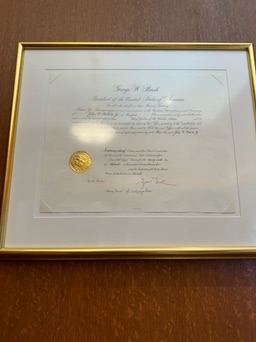
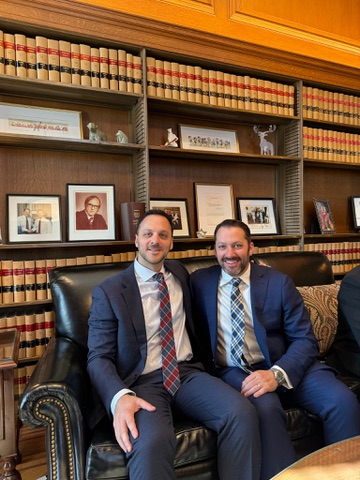
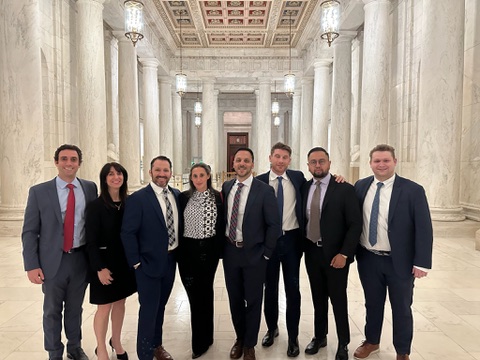
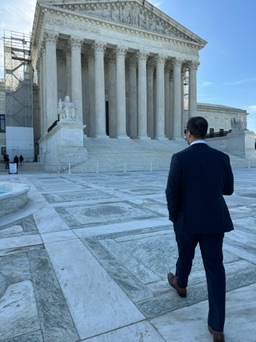
Yesterday, I had the privilege to visit the Supreme Court of The United States as a guest of Chief Justice John Roberts. He’s the 17th Chief Justice of the United States and will likely, and hopefully be, the Chief Justice for the majority of my lifetime.

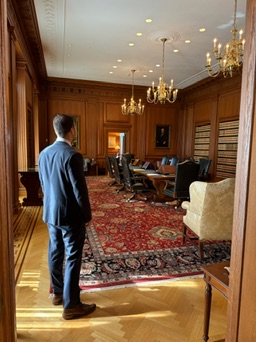
We had an opportunity to spend time with him in his chambers before and after the oral arguments. The two items on the docket were:

  1. DEPT. OF STATE V. MUNOZ
  2. STARBUCKS CORP. V. MCKINNEY 

The oral arguments were undoubtedly interesting, dense in legalese and constitutional law, and dramatic in that you are sitting in the highest court in the land listening to arguments that could change history.

But the thing that left the biggest impression on me is this: it was a reminder that most people who serve our country deeply care about their work and their country.

Of course, some of our elected officials are misguided, but that’s what makes America, America. We get to support candidates we like and vote them into office.

America is not perfect. And if you spend any time on social media listening to pro-Hamas crowds screaming “death to America” you’d realize how imperfect we are.

We still have a lot of work to do, but there are indeed still great people trying to do the best they can. And these people put the country first and still fight, day in and day out, for our republic.

Thank you John, Jack and Sam for a great day.

A Visit To The SCOTUS Read More »

Mostyska, Ukraine – The Field Hospital In The Middle Of A War Zone

My grandmother survived the German invasion of her small town of Mostyska (then Poland, now Ukraine).

Many of her friends and family were murdered there.

My family built a monument there to remember them…

Once again, Mostyska is at war…

But instead of being ground zero for death, Mostyska is now ground zero for life.

It hosts an Israeli field hospital to treat those escaping the Russian invasion of Ukraine.

As a first responder myself, I’ve been donating to organizations sending in first responders and medical relief. One of them is “Uber for first responders”, United Hatzalah.

I’ve been donating in memory of my grandparents, who fled, just as the Ukrainians are doing now.

I had no idea where the first responders were establishing their field hospitals.

But now I know…

My donations are sending medics to save lives on the very soil where my grandmother was raised, and where her family and friends wer killed.

Time and space are connected. Even a small act can leave an impact on generations.

If you are looking for a way to help, please look here: https://israelrescue.org/ukraineemergency

Mostyska, Ukraine – The Field Hospital In The Middle Of A War Zone Read More »

Tomorrow Will Be Better – Vote

On November 11th, 1947, on the heels of World War II, after the fabrics of government and society were torn to shreds in Europe, Winston S Churchill went on to say this:

‘Many forms of Government have been tried, and will be tried in this world of sin and woe. No one pretends that democracy is perfect or all-wise. Indeed it has been said that democracy is the worst form of Government except for all those other forms that have been tried from time to time.…’

Today is election day. As we know, things are far from perfect.

This can be said about most anything.

Our work and Business, our relationships, our finances, our health.

We all want to do better. We all strive for more.

Today, we have the fortunate opportunity to do more for the country that we live in. We are able to make our voices heard, and counted.

We get to vote, and decide who will represent us and help shape our country and the world for a better version of itself.

And in that effort or any effort to grow and improve, there will be pain, there will be stress, there will be disagreements, there will be failure.

Whatever happens today or this week, it’s important to remember that this perfect union called America is far from perfect, and frankly, it will never be. But as long as we keep putting in the work in our own way like voting, by creating new jobs and opportunities, by making our voices heard, by being decent, by being honest, by doing the right thing, and anything else that perpetuates ‘good’ and the values we hope to live by, we should rest assured that things will indeed get better, as tough as they may seem in the moment.

As a comparison, remember that just years ago the world was in a much worse place compared to today.

  • Political grievances were settled with gun duels
  • Mothers and fathers were sending their 18 year olds off to the beaches of Normandy
  • The average life expectancy from 1500s to 1800s was between ages 30 and 40 years old
  • Poverty, hunger and child labor are at the lowest levels they’ve ever been
  • Child mortality is the lowest it’s ever been
  • Homicide rates are the lowest they’ve ever been
  • More people in the world live in a democracy than ever before
  • The literacy rate in the world is the highest its ever been
  • Moore’s law, which describes the empirical regularity that the number of transistors on integrated circuits double every two years, is still tracking since inception in 1971
  • Access to the internet is increasing
  • Solar energy is the cheapest its ever been

By mostly all accounts, the world is in a much better place than it has ever been and I take solace in this fact.

But I also recognize that we must continue to play a role to maintain this forward progress.

So today, please take the time to vote and reflect on what more you can do, regardless of the outcome.

Whatever happens, I’m still the most optimistic I’ve ever been about what’s ahead.

Tomorrow Will Be Better – Vote Read More »

We are the Hip Hop Generation

“I Love Hip Hop” cover
Image via Wikipedia

There was Rock and Roll, Billy Joel, Greatful Dead, Allman Brothers….and then there was Hip Hop. Our generation has grown up with Hip Hop, and along with technology and a few other big cultural game changers, it has defined our time. Our generation.

With the election right around the corner, it seems as if EVERYONE has a say about these candidates and this election. But will the younger voters make it to the voting booths (And I don’t mean the young voters in the video)? My friend is currently exploring this very issue, and it is called Project Youthanized. The issue of apathy within our generation.

It is amazing how many people I know weigh in on the election, yet could not or did not make it out to the primaries. Will they make it out on Nov 4?

Thanks to Jake S for sharing this video.

[youtube]http://www.youtube.com/watch?v=UxlwYP0HNdc[/youtube]

Reblog this post [with Zemanta]

We are the Hip Hop Generation Read More »

America’s Management Team

When the media covers a presidency, they constantly refer to the phrase “The (insert president’s name here) administration”. A phrase that is reflective of a group of people that form consensus, make decisions, and ultimately run our country. They are America’s Management Team.

When American citizens choose their next President and Vice President, why are they only presented with two teams, of two individuals (although, in reality there are actually more options)? As the world continues down this road of globalization, there are many more factors that come in to play. How can two individuals posses the mental capacity and expertise to address all of the different domestic and global challenges? The short answer is, they cannot, thus appointing others to their cabinet and creating new appointments as needed.

Why can’t the presidential candidate declare the following appointments (or at least a select few..one or two even) pre-election day?

  1. Vice President
  2. Secretary of Agriculture
  3. Secretary of Commerce
  4. Secretary of Defense
  5. Secretary of Education
  6. Secretary of Energy
  7. Secretary of Health and Human Services
  8. Secretary of Homeland Security
  9. Secretary of Housing and Urban Development
  10. Secretary of Interior
  11. Secretary of Labor
  12. Secretary of State
  13. Secretary of Transportation
  14. Secretary of Treasury
  15. Secretary of Veterans Affairs
  16. Attorney General

Granted, disclosing all of the appointments may be a bit much. And maybe their can be a different approach that presents more options or more insight. Even so, in today’s world I would be thoroughly interested to see who would take up the following positions pre-election:

  • Secretary of Commerce
  • Secretary of Defense
  • Secretary of Education
  • Secretary of Energy


After all, aren’t we voting on the people who will run our country for the next four years? America’s Management Team?

Just a thought.

America’s Management Team Read More »

Is M”y” Generation Uniquely Apathetic?

This is the question my friend Mark Korshak is looking to answer in “Project Youthanized.”

[youtube=http://www.youtube.com/watch?v=NNqeEcDp_jg]

But how do we truly compare generations?

Let’s consider a student in college 30 years ago, to the student today (The generation Y student). How would these students engage activism?

Years Ago: pass out fliers   Today:  send out emails

Years Ago: organize a rally  Today: create a Facebook group

Years Ago: collect donations (change in a cup)  Today: collect donations (PayPal)

Years Ago: attend a rally   Today: watch a speech on YouTube

Years Ago: start a magazine  Today: start a Blog

Technology must be considered in any cross generational comparison.

Although it may seem as if students today are indeed “apathetic”, I can’t help but wonder, is that really the case? If you’ve ever joined a facebook group, if you’ve ever commented on an article, if you’ve ever published ANYTHING to the web, then you have engaged some form of activism.  You have made your voice heard. The extent of that activism however, is still unknown.

I wish Mark the best of luck in determining, how, if at all, “uniquely apathetic” our generation is, and how he goes about measuring the extent of this apathy.

Is M”y” Generation Uniquely Apathetic? Read More »

Fred Wilson – “And Who Do The Other 17% Think Will Win?”

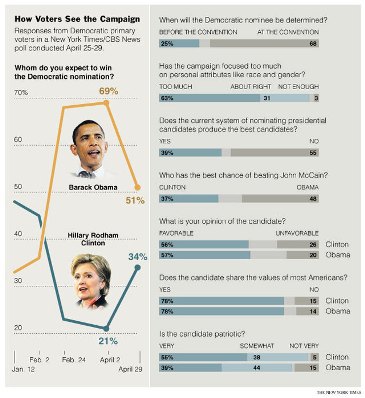
The anticipation of who will be the democratic nominee is growing. Fred Wilson posed a great question today in his post titled “And Who Do The Other 17% Think Will Win?

“My other thought when looking at this chart was “if these were two stocks, what would people be doing with them?”

– Fred Wilson

Behind any investment, their must be substance. Which candidate is proposing ideas that are subtenant, tangible, and practical. We all remember what happened in the dot com bubble when people started pouring money into those revolutionary internet ideas. And who made it out on top?

Substance behind the idea.

Better image here

Fred Wilson – “And Who Do The Other 17% Think Will Win?” Read More »

Scroll to Top