I grew up listening to Hip-Hop and still love it to this day. The beat, the tempos, the lyrics – those are the things that make Hip-Hop great. But there are many songs that stick out above the others. There are those songs that always make me turn up the volume and compel me hit pause at certain parts, so I can rewind, and listen to a specific string of lyrics. Sometimes I do this over and over again. These are lyrics that have stayed with me and they are words I think about in business, in relationships, and in life.
These are just a few:
“Turnin’ nothin’ into somethin’ is God work, and you get nothin’ without struggle and hard work” – Nas, Doo Rags – The Lost Tapes
“I never ask for nothin’ I don’t demand of myself. Honesty, loyalty, friends and then wealth” – Jay Z, Justify My Thug – Black Album
“Now I’m on the rise, doin’ business with my guys. Visions realize, music [your craft] affected lives. A gift from the skies, to be recognized, I’m keeping my eye on the people, that’s the prize” – Common, The People – Finding Forever
“Speak what I want, I don’t care what y’all feel. ‘Cause I’m my own master, my Pop told me be your own boss. Keep integrity at every cost,” – Nas, Bridging the Gap – Street’s Disciple Disk 2
“Every interview I’m representing you making you proud. Reach for the stars so if you fall you land on a cloud.” – Kanye West, Homecoming – Graduation
“Far from a Harvard student, just had the balls to do it” – Jay-Z, What More Can I Say – The Black Album
“Whats up with your motto? Will you lead? Will you follow?” – Nas, My Generation – Distant Relatives
“The victory’s found in truth, like innocence found in youth Self defeat is your own dispute ” – Damian Marley, Strong Will Continue – Distant Relatives
“Sometimes you gotta be an s.o.b., you wanna make a dream reality” – Mark Knopfler, Boom Like That – Shangri-La (not Hip Hop)
I’m rounded up with 12 others and we’re being escorted to a church. The others are quite. They don’t know why they were just abducted from their daily routine and I don’t know either. It looked like some were only on their way to the market and some were on their way to school, like me. I’m only 15. What could they possible want from me? The soldiers are bringing us to a church on the other side of town, but what for? It wasn’t too long ago that they occupied our town and disrupted our lives. I don’t understand. Why are we going to a church? Something is off. This doesn’t seem right. I need to get out of here. I need to run. I must run. I have to run NOW.
I take off in a sprint and I know the soldiers are running after me. Chasing me. Hoping they can round me up and bring me back with the others. I don’t look back though because I’m afraid it will slow me down. I keep running. I make my way back to the center of town and look for a place to hide but I’m not really sure where to go. I need to get off of the streets. I need to be inside. Houses!
I start knocking on the doors of the locals. The first house is white with a red door. I hear people inside but they won’t let me in. I move on to the next house. They open the door at least but also won’t let me in. House after house I’m rejected. Is it because of my age? My clothes? There is still nowhere to hide until finally someone welcomes me into their home. I can see the fear on their face though. Their mild reluctance to let me in. Their hesitation. How could they not be afraid? I’m out of breath and desperate for a place to hide. I would fight them right now if they won’t let me in, but they do. They finally let me in and I sit on the floor to catch my breath.
Hours go by. I haven’t returned home from school and my family must be worried. They don’t know where I am but I can’t go home. I can’t leave yet because it’s too dangerous. I must stay here for the night at least until the soldiers have given up on my search. If they are even searching for me at all. Yes, I need to stay here and I’ll go home in the morning.
When the sun rises I know its safe to make my way back home but I’m compelled to go back to the church first. I need to see what they wanted from us and what awaited for us at the church.
Blood…
The earth is bright red and there is a giant, fresh mound of dirt. I have never seen anything like this before. A mass grave. I was just with these people. I was one of these people.
I feel sick. Confused. Lucky.
I run again, but this time I run home and when I get there I know my life will never be the same.
It’s 1940. Germany has invaded our small town in Poland I’m terrified of what will be next….
Yesterday was Holocaust Remembrance day and this story is one of many my grandfather has from the Holocaust. There is one saying that all holocaust survivors and family members have engrained in their DNA and that saying is “never forget.” I know I will never, ever forget.
The Last Jew of Vinnytsia (Photo credit: Wikipedia)
“Sometimes, it is important to look back and see who in our lives our, ‘angel investors’ actually are. Acknowledge them. Thank them if you can.”
I’ve read similar words before. I read these exact words one day ago. I’ve heard them before from Andy and others, but now I’m a day too late.
When I was just maybe two years old, a woman showed up at my parent’s house to interview for a live-in housekeeper position. She didn’t speak a word of English. Only Spanish. Her name was Esperanza Perez.
My mom said I had the biggest smile on my face and that’s when she knew. She knew that Esperanza was going to live in our house and help raise me and my siblings. I wish I could talk about specific stories in detail, but I was so young. I only remember bits and pieces of those days like watching spanish tv with her. I didn’t understand a thing but she would try to teach me. I remember her tickling me feet, trying to make me laugh. I laughed so hard I was in pain. I called it tickle torture and she loved it because it made me laugh. It made me smile.
That’s really what I remember about Esperanza. She made me smile even when I was very young and I believe those early days of smiling, those early days of compassion, helped me become who I am today. Those interactions helped make my brother and my sister who they are today. I’m proud of that and Esperanza should be as well.
A few weeks ago I tried to tell her those things in person but I couldn’t do it. I literally could not find the courage to say those words out loud when I was with her.
She was in a coma, connected to a breathing machine because she had suffered two, major heart attacks. She couldn’t hear me, but still, I didn’t say the words I wanted to say. Here I was struggling to put a “thank you” sentence together and there she was fighting for her life. Even if I had said anything she wouldn’t have heard me. Some say that people can still hear in those traumatic cases, but the analytical part of me said, “she can’t hear you, so what’s the difference?”
Well there is a big difference.
Anyone that is able to read this post is alive and is capable of saying thank you. I wish I said thank you to Esperanza when she was well. When she was happy. I wish I said thank you when she was lying in that hospital bed fighting for her life.
Esperanza passed away today. I’ll miss her. But I wish I could tell her thank you. Thank you for being a part of my life and for helping me become the person I am today.
I just wish I wasn’t a day too late and I hope you won’t be a day too late either.
If Facebook has taught us anything over the past few years it has taught us this:
Cover of Hackers
1. A hacker culture works to drive accelerated growth in a business. Mark Zuckerberg writes in a letter to his investors, “Hackers believe that something can always be better, and that nothing is ever complete. They just have to go fix it — often in the face of people who say it’s impossible or are content with the status quo.” It’s hard to argue that this approach doesn’t work. Facebook today has over 850 million people and to give you some perspective, that would make it the third largest continent in the world behind Asia and Africa. So clearly, a hacking culture does help move a business and it’s product forward. But why should a hacking culture be limited to a silicon valley technology company?
2. The world is social. Legacy, societal hierarchies no longer exist. Almost every day I encounter new stories with a similar theme: a group of like-minded individuals come together to affect change – and they do so from the bottom up. A great example is something called Cash Mobs, where a group of people visit a local business, as a large group, and share in a collective spending spree. In many cases they can even alter the prices of products. It happens organically and it happens from the bottom up.
Yet another example is one I learned about recently, called “Invisible Children.” This movement is working to disarm Joseph Kony, one of the world’s worst war criminals, from his position of power in Uganda. When the movement first started, the members unsuccessfully challenged government officials to intervene. Shortly thereafter, the organization decided to use social media to raise awareness and demand change. As a result, they were able to to generate participation from hundreds of thousands of people, the original naysayers, acclaimed celebrities and even President Obama. In today’s world, all organizations should expect this paradigm shift to affect their business in one way or another – without their control and without their permission.
So how can businesses embrace a Facebook-like hacking culture that could lead to accelerated growth?
Here are a few corporate hacks you can use to make your company faster and more social:
The “Team Collaboration” Hack: Assembling and curating ideas can be very time-consuming. It can also destroy your email inbox and waste hours of your day. Instead of accruing very long email threads, create a private Facebook group to facilitate the conversation. It is a free, private forum and you can invite only those you want to invite.
The “Customer Service” Hack: Social media is less about “media” and more about real communications between real people. People will either praise your brand or complain about your product so make sure you have people on your team listening to your brand. You can create google alerts or twitter alerts using their search functionality and RSS feeds. This will alert you when certain keywords are mentioned and from there, you can reach out to engage with them.
The “I Need Legal’s Approval” Hack: In many corporations, marketing teams require legal approval. In today’s market there are many recent law graduates looking for work. Think differently about hiring and consider opportunities for lawyers to be an integral part of your social media marketing efforts. You’ll have someone on board that can quickly approve content.
The “Product Development” Hack: Why spend a ton of energy and time trying to figure out what your customers want? Simply ask your customers what products they want and use that feedback in your product development cycle. If you don’t ask, they’ll tell you anyway so you might as well ask.
The “Customer Acquisition” Hack: People are opting in to become fans and followers of certain brands. It is now easier than ever to identify and recruit customers of your competitors. Just look at their social media properties, reach out, and engage in good, meaningful dialogue.
Those are just a few social hacks to drive additional progress in your organization. What else have you seen?
What would you say if I told you I was going to make stick figure cat drawings?
Your first response may be to highlight the fact that I’m above the age of 4. Now what if I told you that this was not a child’s arts and crafts project, but my business idea. Not only is this my business idea, but my sales pitch includes a song and dance called, “I want to draw a cat for you.” What would you say then?
I think many of you would ask me if I’ve lost my mind and that would be a fair question. However, the truth is that absurd business concepts, even dramatically idiotic ones like stick figure cat drawings, can be brilliant, revenue generating businesses so long as they are properly executed.
On ABC’s Shark Tank, a show where investors get pitched and invest their own money, a guy named Steve Gadlin walked into a room, stood before five prominent investors and proved that execution is all that matters. He danced, he sang, he pitched a business predicated on cat drawings, and secured an investment from Mark Cuban, a billionaire investor and owner of the Dallas Mavericks. This is something worth seeing for yourself.
The lesson to be learned here is that there is so much more to a successful business than just the idea. The trick to taking a business idea and turning it into a successful reality is all in the execution of that idea. It’s about taking your concept, regardless of how “out there” it may be, and making it work even if those around you liken your idea to the works of a 4 year old. It takes inventiveness, creativity, and lots of hard work.
Many of todays greatest inventions, if turned into a sales pitch, would be as television worthy as stick figure cat drawings. Just imagine what a Wright brother’s sales pitch may have sounded like. “So you see what those birds are doing? Yeah, its basically like that but with lots of wood and metal. Wanna invest?”
We encounter people every day who come up with crazy ideas, but the people that succeed are the ones that can execute. They are the people whose convictions and beliefs outweigh the objections and negativity of the naysayers.
So as I look out of the window and watch the planes fly overhead, I’m constantly reminded that no idea is too small or too stupid. Ideas don’t mean anything without good execution. And if the planes aren’t enough of a reminder, I suggest you order a picture of a stick figured cat and hang it above your desk.
Our society celebrates the buzzy and bubbly – acquisitions, funding events, mergers, new hires. As entrepreneurs, most of the buzzy stories we read are rather useless. They serve no practical application to help grow our respective businesses. This is why great entrepreneurs get out in the field and engage in as many conversations as they can with those they respect. They want to hear firsthand how people have succeeded and how people have failed. They search for tried and true lessons so that they can apply the takeaways to their own ventures. And in this process entrepreneurs uncover key insights that may lead to a critical pivot in a business model or perhaps may lead to a simple validation of an already held mindset. From my vantage point, all of these little stories serve as an important backdrop for anyone looking to build a great business.
So here are three short stories from three up and coming New York City startups. Maybe you’ll uncover a gem of insight that will help transform your business or project.
“No Silver Bullets” by Aaron, CEO & Co-Founder of Tutorspree
The hardest lesson I’ve learned since co-founding Tutorspree is that there are no silver bullets – even when charting something as amazing as the future of one-on-one learning. It may seem a bit strange that I need that as a lesson when everything else I’ve ever done has required huge amounts of hard work. Intellectually, I had no expectation that a startup would be any different. But emotionally, entrepreneurs are continually confronted with stories in the popular press full of the one huge a-ha innovation/decision/partnership that “made” a company. While I know that those may be possible in extreme edge cases, that they’re nowhere near the norm, and they create an irrational expectation that one is just around the corner.
The truth is that start ups are hard, they’re a slog, they’re a huge amount of all consuming work – but that’s also why they’re amazing. You don’t find a single silver bullet – that’s the just the story people tell afterwards, you find a whole bunch of little steps and you figure out how to string them together until you have your success. And looking back, that’s a bigger achievement than a single fell swoop, which might be as much luck as anything else. That’s a lesson I take into work with me every day, and it is a critical piece of what makes this the life I want.
“Motivation by Inspiration” by Mike Dirolf, CEO of Fiesta
For me, motivation has been the principle benefit of working from a co-working space in New York City; collaboration is a distant second. It’s great to have smart people around to ask for help and feedback, but it’s far more important to see how hard those people are working and to be inspired to keep up. At almost all hours of the day the space is filled with people working as hard as they can to turn their fledgling companies into successful businesses. It’s impossible to walk into the place and not feel energized.
A little over a year ago I set out on my own and was ostensibly working from my apartment. The reality was that I had a lot of trouble staying focused. About a month later I moved into a co-working space; since then staying motivated hasn’t been a problem. Now that Fiesta is growing and I’ve brought on a co-founder that external motivation might be less essential, but I’m convinced we never would’ve gotten this far without it.
“Colloboration” by David Reich, CEO & Founder of Assured Labor (Disclosure: David Reich has no relation to Dan Reich
Our company, Assured Labor, is an unusual start-up. Started at the MIT MediaLab, Assured Labor connects employers in emerging markets with local sales, operations and administration candidates using cell phones and web technology.
We have a staff of 15 (including our outsourced engineering team) distributed between Mexico, Brazil, Pakistan, Nicaragua and of course, our headquarters in New York City at Dogpatch Labs. We’ve often been asked why we keep our headquarters in New York while all of our operations are based in the emerging markets. The answer is collaboration. Our New York base allows us to collaborate with the world’s best engineers and business innovators, ensuring we can outcompete our local competitors. I’ll give an example of each.
Engineering. While we have been happily working with an outsourced technology team based in Lahore, Pakistan, we keep our senior technologist and product manager in the US. This is for two reasons: first, this is where the worlds top talent is, and second, to provide our talent with the opportunity to collaborate with likeminded entrepreneurs. In our incubator there is no shame in asking questions or fear that collaborators (from other companies) will steal our idea. This ecosystem allows our engineers to learn from peers other and build better services faster.
Business Innovators. Over the past year dozens of startups have come through Dogpatch Labs, each with it unique ideas on how they’ll monetize their business. I’ve seen Groupon models, Ad based models, Subscription models, Freemium models, Co-marketing models, and a dozen more. Each month notable experts come through Dogpatch to meet us, ranging from the Scott Heiferman of Meetup.com to Eric Reis the author of “The Lean Startup”. But best of all I’ve had the opportunity to learn from my fellow founders while sharing my opinions on what I’ve seen working both internationally and in the US. As technology is only part of building a successful startup these opportunities to collaborate with business innovators is a tremendous advantage.
Beyond the opportunity to collaborate in engineering and business innovation the collaborative environment of our co-working space has provided us with introductions to investors, employees, interns and partners. We also lean on each other for energy and motivation, sharing in each other success. While few things can match the business learning that comes from sitting with your customers, few things can match the business building to be gained from collaboration with other entrepreneurs, in the trenches, working to change the world.
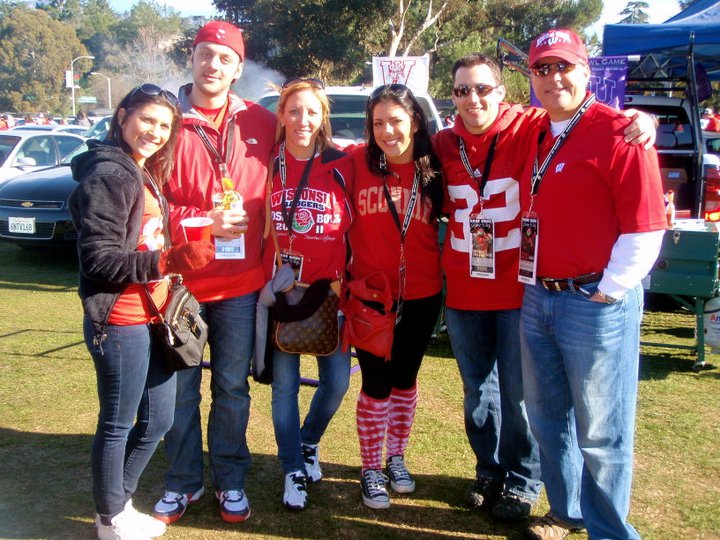
In January I took my first trip to Pasadena California for the Rose Bowl. Although Wisconsin lost to TCU, it was arguably one of the best weekends of my life. Being able to spend a new year with all of your friends and family while watching your team play for some Roses is a great way to spend a new year.
From January to May we cranked up the activity over at Spinback. Late nights, lots of meetings with clients and investors, hours of brainstorming, all led up to the eventual sale of our company to Buddy Media.
In June we got rolling with the integration between Spinback and Buddy Media.
In July I took a trip to Italy and got engaged to a great girl. We visited Rome, Venice, Florence, Pisa, Tuscany, and drank entirely too much wine. I quite honestly thought this decision would have come later in life but most of the time things work out differently than anticipated and in this case it couldn’t of worked out any better.
In August I got my first glimpse of what Law School is really like when I visited my brother at school and got the full download. He’ll make a great lawyer one day but for now he’s grinding it out as an L2.
In September I started writing for Forbes.com and I think I underestimated how much time I would have to write about businesses while trying to build one.
In October I completed my 9th recertification as an Outdoor Emergency Care Technician, otherwise known as Ski Patrol. This marks my 10th year as a member of Mount Snow Ski Patrol and there is nothing better than great skiing, with great people, all while saving lives. I also celebrated my 26th birthday in October and on the same day received news that changed my entire perspective on life (more on that much later).
I don’t recall anything special happening in November, but..
In December my sister celebrated her 21st birthday marking the end of the “children” era in my household. She’s fully immersed in a nursing program and will make a great nurse or doctor one day.
And now we’re back at January. Wisconsin is playing in the Rose Bowl again and I’m so grateful for a year that I was able to share with friends and family, both new and old.
Technology has democratized information and in turn has fueled hyper consumption. On a daily basis, we are assaulted with new content that we must consciously choose to engage with or disregard. Whether it is a text message from a friend, a real time twitter feed, the latest youtube sensation, or even this very blog post, we are constantly plugged in to a hyper connected media network – one that actually causes a paralyzing and counterproductive affect for us as individuals. One engineering professor explains: “I feel that the iPad is yet another electronic toy to distract people from the hard work, focus, and dedication that a productive life requires.”
But here in lies a paradox. If you managed to navigate to this article to read this post, chances are good that you, like me, have a desire to consume information in order to improve various aspects of your life or business. It’s natural to think that more content consumption will increase our chances of success, because after all it is a learning experience, but as a fellow entrepreneur puts it “there are days where I’m always working but by day’s end, I feel like I’ve accomplished nothing.”
So how do we disconnect from all of this hyper consumption in order to really pursue a productive life or career?
1. Focus on one thing and one thing only. When you eat, eat. When you read, read. When you work, work. How many times have you been in a meeting or out to a meal and a member of the party breaks out their phone and starts checking email? In order to thoroughly disconnect from this always-on network of information, we must be willing to compartmentalize certain activities so that we are really only doing one thing at a time. This is an extremely difficult task especially when you have web browsers and technology that can simultaneously let you read email, read articles, listen to music, chat with friends, and watch videos all at the same time – tab by tab, app by app.
2. Connect with nature. Leave your phone at home and take a walk outside. Better yet, take a weekend trip to a beach, a park, a resort, or any place where you enjoy the peacefulness of nature. Looking back on my experiences, I’ve found that mostly all major decisions I’ve made were made while taking a walk or sitting alone outside. In fact, in Walter Isaacson’s new book on [entity display=”Steve Jobs” type=”person” active=”true” deactivated=”false” key=”steve-jobs”]Steve Jobs[/entity], there are many instances where Steve goes for a walk in order to address some critical aspect of his life or business.
3. Pick up a hobby. Part of the reason I write articles like this one is because for the hour or so it takes me to compose this piece, I am not doing anything else. A colleague of mine described his favorite hobby, surfing and said “when I’m sitting on my board in the ocean, I’m only thinking about one thing – when the next wave is going to come.” In this resolve and dedication to a hobby or sport, we can find solace and peace from our pressures of every day life.
Once you are able to truly disconnect, you can begin to focus, with a clear state of mind, on things that matter. You can begin to work on things like overcoming career anxiety or maybe even getting started with your very own business venture.
Do you have special tips or tricks for disconnecting?
If we want our country and economy to get back on track we need to fix the education system for math and science related degrees. It’s simple really and everyone knows it. Growth happens when people build and sell things. In an age of high tech innovation those “growth” building blocks rely squarely on the skills acquired in a science, technology, math or engineering curriculum. It’s why the president and other industry groups are advocating for more students to graduate with these degrees.
In a recent article in the New York Times, Christopher Drew talks about “Why Science Majors Change Their Minds.” He really highlights some of the systemic issues that are engrained in our institutions but having experienced firsthand what it’s like to study engineering, I can tell you what’s really going on.
Cramsorption Learning. How fun is this? 2 hours a day, 3 days a week, a professor stands up in front of a classroom and paraphrases sections from a chemistry text book. After a few weeks of lectures and labs, the class is ready for its first test. A few days before the exam the libraries are pact. Students cram all of the formulas and anecdotes into their brains because in a few hours they will be responsible for regurgitating those same formulas onto a test. And once that test is finished, all of that information evaporates. Why? Because now the students need to focus on the next chapters and shortly thereafter they’ll have their next exam. By the next semester most of the learned information will go to waste because there was never any real practical experience applied to the information in the first place. Cram, regurgitate, next.
Learning from experience. One of the best Electrical Engineering classes I ever took was in high school during my freshman year. It wasn’t an EE class per se’ but it just as easily could have been. My teacher David Peins, basically said to the class, “here are some parts, here is how to make a Printed Circuit Board (PCB), and here are some circuits. Go build a firefighting robot that can autonomously navigate a maze and put out a fire.” What ensued was what all engineering programs should be like. We had to figure things out on our own and when we had questions, which we did almost all the time, we would ask Mr. Peins. By the end of the class we had learned about resistors, transistors, tute-bot circuits, and an entire foray of engineering concepts. I didn’t even learn about transistors until my junior year in my real ECE major. In high school, I learned these concepts by doing and not by sitting in some lecture hall taking notes.
Grades, grades, grades. I got a 2.5 GPA the first semester of my freshman year. I thought I could do what I did in high school – almost nothing and get by with good grades. My other college buddies thought the same thing. It turned out they did much better than I did freshman year, but it was also true that they were not pursuing a degree in STEM (Science, Technology, Engineering, Math). So here I was taking extremely hard courses, working 3x as many hours as my peers for crappier grades. And as school progressed it was time for me to start thinking about my future. At one point I thought about attending the London School of Economics. I gave them a call and they said I needed a 3.5 GPA regardless of my major. So here I was thinking about my future and I was already at a disadvantage because my major produced historically lower grades than other majors. Had I really wanted to go to the school I might have switched. I know I debated it almost every day for two years.
School Rankings. The end justifies the means. I heard a story once that went like this. A university had a top program for entrepreneurship. The best students from the STEM majors wanted to put their skills to work so instead of taking jobs from some of the top, high paying companies like Google or Intel, they choose to work on their own projects. Great, right? More entrepreneurs. Bring it. Well that university ended up cutting back on that program because those high quality students weren’t taking those high paying jobs. And when part of a school’s rankings are predicated on graduate’s starting salaries, you might see why long term opportunities were sacrificed for short term gains. We’ve seen this story before though – see Wall Street.
Money, money, money. In college, my buddies and I came up with this great idea that we thought would change the world and make us a lot of money. We realized that millions of cars each day were driving over speed bumps in the roads. These speed bumps were put in place to force the car to slow but consequentially there was also a lot of energy going to waste during this process. We thought that we could harness this lost kinetic energy and pump it back into an electrical grid. So we went to work. We started developing the equations and formulas needed to make this happen. One of our professors was helping us but after a while he asked, “why are you doing this?” Thinking this was already an obvious answer, we responded “because it’s a great idea and it will make us rich.” He quickly began to tell us about a fellow engineering friend of his who came up with several inventions but ultimately went to Wall Street because he wanted to get paid and he was having a hard time turning inventions into real products and businesses.
Its Hard. One of my exam questions once was, “How much fuel do you need to get to mars?” That was it. We needed to account for the earth’s gravity, various altitude levels, the trajectory of the flight path, the mass and weight of the ship, and so on. This was a straight up NASA question and I was barely doing well on my calculus exams. The reality is that most STEM majors have topics that are extremely difficult and sometimes they are just too hard too complete. How did I deal with this? I just worked harder. Was it worth it? It was for me but most others deferred to the “Grades, Grades, Grades” section.
Changing the Status-Quo. The feeling I get with most STEM course work today is that they were designed for a 9 to 5 industrial age with the goal of producing great workers for great companies in a non-global economy. This reverberated through my mind as I sat in those giant lecture halls. But now we are very much in a competitive, global, all-hours-of-the-day economy. We need a system that rewards risk taking and encourages people to pursue challenging academic careers. This is not happening today because we are too focused on school rankings, easy grades, short term gains, and maintaining the status-quo.
Sooner or later these issues will be addressed and they will most likely come from someone who has the building blocks to address and engineer real problems. I just hope more people stick with Science, Technology, Math and Engineering and don’t change their minds.
Technology and data are changing the ways companies do business but perhaps more interestingly is the way they are influencing how companies are hiring, and could be hiring, new employees. In many organizations the human resource department is considered the most important part of the organization. And rightfully so. A company is nothing more than the people within it so it should be no surprise when you hear about how rigorous some hiring processes are. For example, its been said that Google has had candidates come in to interview “as many as 16 times before ultimately releasing them back to the wild.”
So let’s take a look at three new and innovate concepts that may help drive the future of how companies are staffed.
The Social Graph. It’s not what you know but who you know. We’ve all heard this phrase before but we finally have social graphs that are accessible through technology. These are social graphs and social connections that will at some point be used to help us as individuals in our careers. So imagine how powerful it would be if companies could leverage one’s social network to get personal references at scale. A company called Jibe is doing this and their employers have said that Jibe candidates are 4x more likely to be hired than those from traditional job boards. And it makes complete sense. Personal references are invaluable and its why 92% of hiring managers in 2010 used social networks as a recruiting tool, according to CareerEnlightenment.com.
Statistical Data Models. If data exhaust was actually smoke we would all be suffocating by now. The abundance of raw data is staggering and making sense of it all can be a daunting task. It is the reason new cloud computing based companies are starting to emerge. But capturing and understanding data is very different than taking actionable steps from the findings. There is a new school of thought among firms that look to statistical models as the basis by which candidates are hired. For example, every company has an associated cost with hiring and training a new employee. The cost of hiring this new employee is recouped if that person stays for a certain period of time. If however that candidate leaves before that time, the firm realizes a loss in opportunity costs. So what if you could predict with a high level of probability that a candidate will stay beyond a certain period of time? What if you could essentially predict which candidates are retention risks? Well this is what one, stealth-mode Chicago firm is working on and their results could end up saving firms millions of dollars annually in their hiring process.
Niche Data Sets. Hiring a math teacher is very different than hiring a quantum mechanics physicist. As the world continues to slice itself up into niche verticals, it will also be important to have niche data sets especially for the purpose of hiring highly specialized candidates for very specific roles. This is probably the reason why LinkedIn (NASDAQ: $LNKD) has seen its biggest growth in revenue come from its hiring solutions line of business. This is also probably part of the reason why LinkedIn has subtly added new fields like “skills” into profile pages. These fields make it easier for recruiters and hiring managers to look for people with very specific skill sets. And just as the ladders.com tailored to folks looking to make over $100k, I believe there is also an opportunity to specialize on other niche verticals like B2B sales, pharmaceuticals, nuclear engineering, and many, many more.
New solutions will continue to emerge but I think we are beginning to see the future of how new firms will hire employees.