Think

Are You In College And Thinking About Your Career?

Fred Wilson recently wrote a post about one of his portfolio companies and its search for interns in the NYC area.

In the Post…

Greg Yardley, founder/CEO of our portfolio company Pinch Media tells the following story about graduating from college and facing the career question:

When I finished school, I had a MA in Russian history and absolutely no idea what to do with myself – I started working as a customer support rep at an Internet startup because they were the first ones to offer me a job.  (If the startup was a week later with the job offer, I’d probably be a 911 emergency operator today.  Sometimes life can lead you to unexpected places.)  I was surprised to stumble across a field that I loved – soon I became a product manager, and now I’m the co-founder of a company. You never know – maybe there’s a career here for you that you’ve never considered.

Greg’s words could not be more appropriate to the current state of my career/life. Having recently graduated from college, I was faced with a choice:

  1. Enter the working world (with a conservative approach) – Get a job with will respected, high profiled employer. Good resume builder.
  2. Enter the working world (with a less conservative approach) – Join a startup, work on my own startup or company.
  3. Go back for more school – Law School, Masters, 5th, 6th year, etc.
  4. Travel and relax for a year or so

My original intent was to go back to school, however a unique opportunity presented itself, and now I am in the working world taking a less conservative approach then most of my peers.

As Greg said, “Sometimes life can lead you to unexpected places.  I was surprised to stumble across a field that I loved.”

This could not be more true.

Are You In College And Thinking About Your Career? Which decision would you make and why?

Are You In College And Thinking About Your Career? Read More »

New Perspective

My mouth has been wired shut for 3 weeks now due to genetics and orthognathic surgery. As a result, I have not been able to speak, effectively engage in verbal conversation, or eat any food. Within this 3 week period, I have also lost a close friend adding significant layers or pain, discomfort, and tension to an already difficult time.

But through this extremely unpleasant experience, I can undoubtedly say that I have gained some new perspective on many things. I’m sure I’ll be better for it in the end.

What does it take to gain a new appreciation, a new outlook, or a new understanding?

* My friend Ceci is traveling abroad, alone, for one year. I’m sure she will be better for it in the end as well.

“I heard people speaking everything from English, to French, to Arabic to Spanish to African dialects, and I had never felt like I had stuck out as so different in my entire life. I suppose this is why I’m here; to occupy my observational post as an outsider…”

New Perspective Read More »

New Ideas – Y Combinator

Startup Ideas We’d Like to Fund
Paul Graham
July 2008

When we read Y Combinator applications there are always ideas we’re hoping to see. In the past we’ve never said publicly what they are. If we say we’re looking for x, we’ll get applications proposing x, certainly. But then it actually becomes harder to judge them: is this group proposing x because they were already thinking about it, or because they know that’s what we want to hear?

We don’t like to sit on these ideas, though, because we really want people to work on them. So we’re trying something new: we’re going to list some of the ideas we’ve been waiting to see, but only describe them in general terms. It may be that recipes for ideas are the most useful form anyway, because imaginative people will take them in directions we didn’t anticipate.

Please don’t feel that if you want to apply to Y Combinator, you have to work on one of these types of ideas. If we’ve learned nothing else from doing YC, it’s how little we know. Many of the best startups we’ve funded, like Loopt, proposed things we’d never considered.


GREAT LIST. GREAT IDEAS.

http://ycombinator.com/ideas.html

New Ideas – Y Combinator Read More »

If only Facebook created their own Microsoft Exchange

How great would that be? For those of you that are not familiar with Microsoft Exchange, the idea is this: Being able to sync your phone with Facebook. Everyone in your Facebook social graph becomes a contact in your phone.

Some things you could do with such a solution:

  • Anytime your friend buys a new phone or changes their number, they simply make the edits themselves in their Facebook account, and the number becomes available in your phone.
  • If you add a new friend on Facebook, you can choose to include them in your “Mobile Sync” setting allowing you to choose, whether or not you’d like this new “Facebook Friend” as a contact in your phone.
  • Text messages becomes Facebook messages.
  • Your Facebook newsfeed becomes a newsfeed on your phone.

I’m probably going to buy the new iPhone when it comes out. In the past, I’ve stuck with Windows Mobile devices because it allowed me to sync my contacts, email, calender, and tasks with my Microsoft Exchange Server (I run MS SBS out of my house). But instead of updating all of my contact information time and again in outlook, I’d prefer a system that utilizes self published user information; aka: Facebook.

As Apple and Google have been addressing the mobile market in new and innovative ways with the iPhone and Android, it seems to me that Facebook is in the best position to capitalize off of the “network” business.

ON A SIDE NOTE: I’ve also been looking for a tool that seemlessly syncs outlook Contacts and calender with my Facebook account, but I haven’t found one yet. This would be ideal.

I hope Facebook comes out with either of these solutions.

If only Facebook created their own Microsoft Exchange Read More »

Organizing the world’s heath

Of all the doctor’s offices I’ve ever been in, I can undoubtedly say they all have one thing in common: The overwhelming amounts of patient files and folders. Next time you go see the doctor, take a look behind the front desk. You will most likely find the sea of colored tabbed, manila folders, each one corresponding to a different patient.

Think about this for a second. Each medical office or facility has huge amounts of patient data that exist in isolated silos. If I were to visit two different general physicians, I would get two different examinations, with two different diagnoses, two different perspectives, and two different data sets on my health. Although they may be very similar, they will most certainly be different to some degree.

With the advent of the internet, the social web, search optimization, and relational databases, it has become increasingly easier to share and access information.

Why can’t we apply the same methods to our own heath? Imagine if every doctor’s office shared one database, offering more insight to a patients health. Granted privacy is an issue and a big concern. But what if those patients lived in the database as ID’s rather then name? The patient would be completely anonymous, and doctor can gain new perspective to a patient’s health they may not have previously had.

Now imagine the database existed in an open source, atlassian-like structure. If the doctor was trying to diagnose a patient based on a list of symptoms, they could hypothetically type in some keywords into the database, and have real time, real world patients at their finger tips (with no personally identifiable information). It would be like a real time, global medical journal. Doctors would have to qualify in order to participate in the database.

Ultimately, the patient wins as their health becomes an open source project for all of the doctors that participate, without their indentity ever being known.

Organizing the world’s heath Read More »

Online Monetization: Beyond Advertising and into Microstransactions

Let me start by saying this: I firmly believe online advertising is and will continue to play an essential role in the economic ecosystem of the internet (so much so, that I am working at Lotame). With that said, is online advertising the only answer?

Arguably No.

Microtransactions: According to learnthat.com

Microtransactions Definition

Microtransactions are small transactions, perhaps of the order of a cent. They are being considered for digital content on the web (a magazine selling an article (unbundled) rather than an entire issue (bundled with additional information that may not be of interest to the consumer). This may then open up additional revenue streams for the content providers.

As new web services, application, or any website for that matter becomes available, the priority typically lies with the user base and generating lots of eyeballs. Once that user base has reached significant mass, the service can leverage the base and monetize.

So if a company like twitter were to offer subscription based premium services, they could, in theory, generate revenue from their loyal users. But what happens if they applied a micro transaction type revenue model? What if they generate revenues based on individual actions (using a feature of the service), or premium actions (using a premium feature of the service), and charge users a fraction of a penny for the action. Granted there would have to be a standardized pay-pal like model behind this type of system, but the amount of volume or interactions that exist online, could yield significant revenue. Make sense?

There are definitley issues surrounding this idea (haven’t though them all through), but the premise is there.

Online Monetization: Beyond Advertising and into Microstransactions Read More »

Educating youth with subject matter that matters

A while back I wrote about the relevance (or lack their of) of the systematic approaches taken by the public school systems and large universities. I would argue that practical and relevant hands-on approaches need to be implemented to better educate the youth in such a competitive global economy. In many instances, parents recognize the need for specific types of education. In fact, one of my relatives has a tutor come to his house once a week to teach his son conversational Japanese, as his business realizes economic growth with Japanese based companies. Fred Wilson also recognizes the importance of practical education and so, in his post today he writes:

“But this year we went one step further. We got our son Josh a young teacher who came over in the evening once a week and taught him how to write code and make a rudimentary computer game. We didn’t know of anywhere in the city to send Josh for this kind of class, so we contacted a local company, Blue Tomato, that provides supplemental tutoring and test preparation.”

Imagine a classroom that prepares students for TODAY’s world, for TODAY’s challenges.

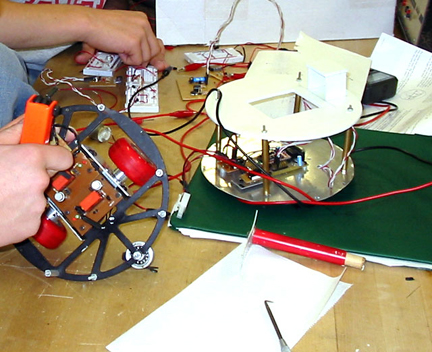
I was fortunate enough to have a high school teacher that also recognized the extreme importance of technology in the classroom (I thank him for his role in influencing me to pursue Electrical Engineering). His name is David Peins and his company is Robodyssey. In his high school Robotics class, we were taught math, physics, electronics, and computer programming all while building robots (my robot can be seen below), and this all happened between the 9th and 12th grade. I learned about semiconductor devices, NPN, PNP transistors, tutebot circuits, and more, 3 years before they were even introduced to me in my Semiconductor Devices classes, (my junior year of college).

If America is going to keep up with the ever changing, fast paced global economy, we need these types of teaching mediums. One that provide relevance to today’s technological and societal challenges, while extracting the most value out of a classroom setting.

“I believe in engaged education and I believe in pushing the envelope and trying new things. Things like this.

Our kids are growing up in a different world than we did. We have to teach them using these new tools. Not just the ones that were used on us.

Fred W. could not be more right.

My Robot (and Chris Murphy) from HIGH SCHOOL: (The robot was a self-navigating, automated fire fighting robot. It autonomously navigated a maze using ultrasound and infrared sensors, found a lit candle in one of the rooms, and blew out the candle)

Educating youth with subject matter that matters Read More »

What do you have to lose…

If you have everything to gain and nothing to lose?

If you have everything to gain and everything to lose?

If you have nothing to gain and nothing to lose?

If you have nothing to gain and everything to lose?

And even if the above applies, what happens if you act “As If..” ?

What do you have to lose… Read More »

Today’s Music Label

If Sony BMG, Universal Music, Def Jam, Motown, Warner Brothers, or any of the big music labels were to create their business model today, what would it look like? First, a quick glance at their methodology:

The old model was simple:

  1. Provide the artist with resources to create an album (Studio, equipment, personnel)
  2. Manufacture the Album (CDs)
  3. Distribute the Album (Stores)

Clearly this model has failed while trying to apply it to todays marketplace. Here is why:

  1. Provide the artist with resources to create an album (Studio, equipment, personnel). Artists can download superior programs and can obtain quality hardware.
  2. Manufacture the Album (CDs) Everything is digital. No need for tangible items.
  3. Distribute the Album (Stores) Distribute the Song/Album (iTunes, MySpace, YouTube, etc).

Because these music labels have not completely adapted or changed with the times, they have been resorting to legal action. (Larry Lessig goes into great detail about the issues involving innovation, technology, and law…his blog is definitely worth reading)

If the music labels reinvented themselves or started from scratch, what would their business model look like? I’d first argue that the first three points need to happen. Resources to create the music, making music, distributing the music. With the advent of cheaper hardware, P2P file sharing, and social media, these points can be easily attained.

But where do you go from there?

Social Media Music Label – An organization that can most efficiently and effectively market and distribute songs. An organization that can generate a brand that encompasses a group of artists, while sharing revenue to some capacity. An organization that leverages the brand to obtain revenues outside of direct music sales. A brand that engages the listeners/users on every level from audio, video, blogging and networking.

I don’t know exactly what that model looks like, but we can just take a look a Chamillionaire‘s success and realize the rules have changed. (Below is Pete Cashmore’s interview with Chamillionaire)

[googlevideo=http://video.google.com/googleplayer.swf?docId=-4798499561605779000]

Today’s Music Label Read More »

Scroll to Top