Think

Google and Social Networking

Until now, Google has been trying to identify efficient advertising solutions for social media.

And rightfully so.

Social media has become the premier medium for communication and media, and over the past few years, Google has arguably become the face of the internet.

So Google figuring out the social networking issue is a logical and expected event. The only question is, what would such a solution look like?

In a recent BusinessWeek article, Heather Green discusses such a solution:

“Say there’s a group of basketball fans who spend a lot of time checking out each other’s pages. Their profiles probably indicate that they enjoy the sport. In addition, some might sign up for a Kobe Bryant fan group or leave remarks on each others’ pages about recent games they played or watched. Using today’s standard advertising methods, a company such as Nike (NKE) would pay Google to place a display ad on a fan’s page or show a “sponsored link” when somebody searches for basketball-related news. With influence-tracking, Google could follow this group of fans’ shared interests more closely, see which other fan communities they interact with, and—most important—learn which members get the most attention when they update profiles or post pictures.”  

While the above excerpt may not be completely reflective of Google’s new, soon to be, patented technology for “ranking the most influential people on social networking sites”, the basic premise can be understood, with the premise being:

Peopleactionsinterests, ENGAGEMENT and INTERACTION are the most important aspects of social networking sites.

Can a company, whose core technology is based on search, truly harness the power of engagement and interaction? Possibly (and if anyone can do it, Google will).

Can a company, whose core technology is based on engagement, truly harness the power of engagement and interaction? Most definitely (and if anyone has been doing it, it has been Lotame).

NOTE: This article can also be found @ the Lotame Blog

Google and Social Networking Read More »

Free Market Economy

Not in one anymore.

Consider this: This is the first time in my lifetime, as well as the lifetimes of everyone in my generation, that we are experiencing something very, very BIG (financially)…or as Warren Buffet put it…

“We are facing financial Pearl Harbor”

The real effects or magnitude of this situation are still incomprehensible to me.

Once this bailout officially goes through, which it will, the financial industry will never be the same. The private sector will never truly be private (at least not for a while), and a socialist economy will begin to take shape. 

Individuals with real ingenuity and innovation in the financial markets, along with strong ethical and moral values will spark new oppurtunities and blaze a path that will hopefully bring us back to that free market.

These heroes will most likely come from my generation, and hopefully, they will not succumb to exploitation tactics in search of quick riches. 

I hope those heroes come sooner, and I hope those heroes make their way to leadership positions within our government.

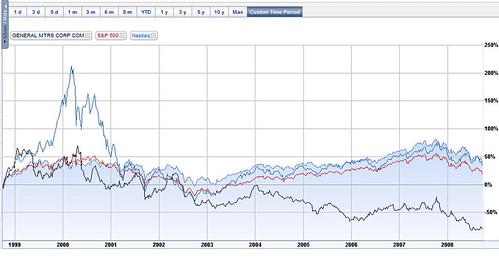
I was curious to see what the markets looked like from the year I was born (1985) until today. Below is a snapshot that displays General Motors, S&P 500, Nasdaq, and the Dow Jones Industrial Average from 1999-present day.

No analysis here. Too busy contemplating the future.

Free Market Economy Read More »

Something Called Validation – TheCampusAtlas.com

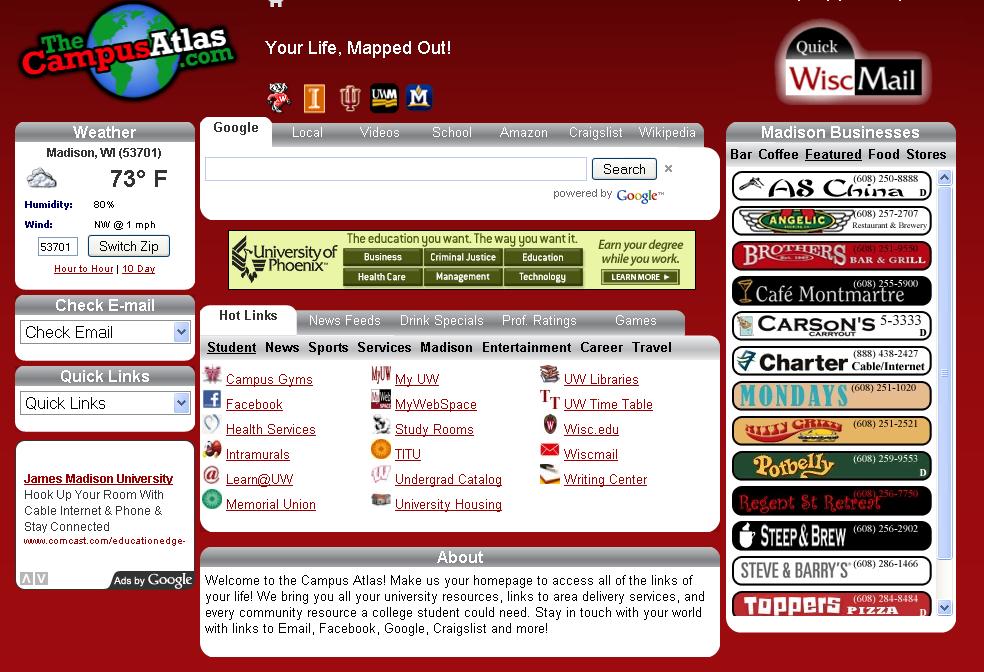
Two years ago I co-founded a website specifically designed for college students. The site:

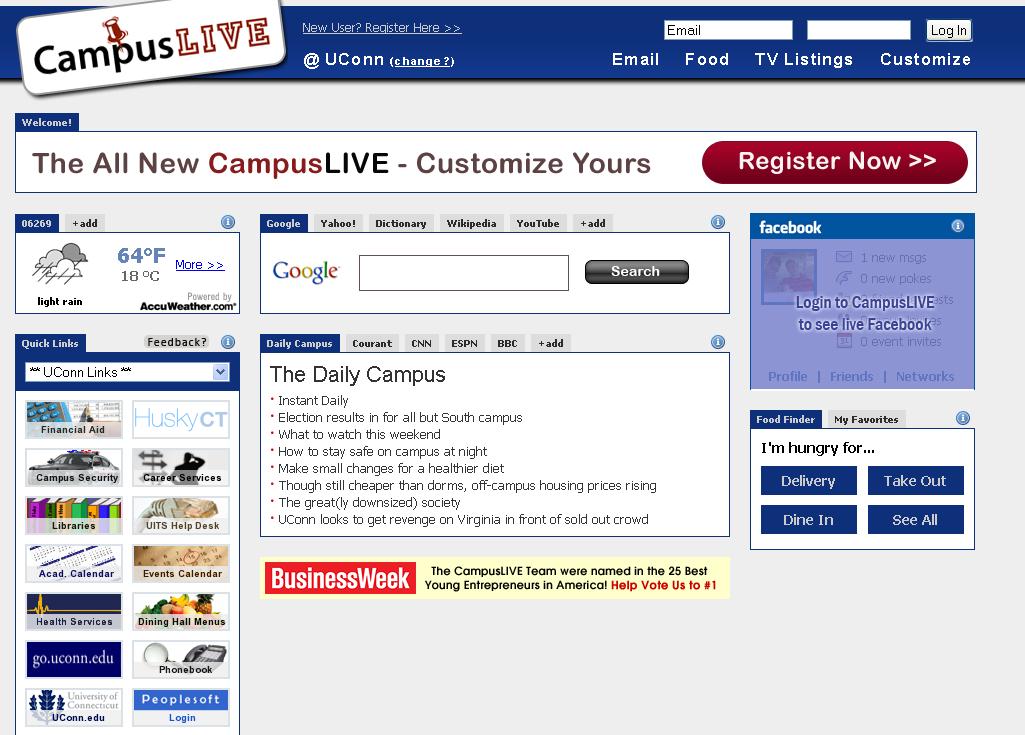
(Check out my site before continuing to read the rest of the post…or look below. You will understand why)

CampusAtlas
CampusAtlas
CampusLive
CampusLive

Today, I see the following article in :

2008 Finalists: America’s Best Young Entrepreneurs

CampusLIVE

CampusLIVE

Jeff Cassidy, 23; Boris Revsin, 22; Jared Stenquist, 23
www.campuslive.com
Amherst, Mass.

Will college students use a Web site devoted to helping them find campus services and local businesses? CampusLIVE cofounder Jared Stenquist thinks so. About a year and a half ago, the self-taught Web developer started the site as a hobby in his University of Massachusetts Amherst dorm room. When advertisers started to contact him, he took a leave of absence to develop the business.

The site can now be customized for 18 campuses around the country, including the University of Vermont, University of Connecticut, and George Mason University. Stenquist, who isn’t planning on going back to school, says the business, which employs five full-timers as well as interns, had just over $100,000 in revenues in 2007 and is negotiating a $1.25 million seed round with a group of angel investors. He expects it to be profitable by January.

Besides the fact that their site looks exactly like TheCampusAtlas, and besides the fact that they started after TheCampusAtlas did, the fact that BusinessWeek considers the idea worthy, is validation.

Validation that our insight into a market need actually existed, and validation that the need could be executed in a successful manner.

While I congratulate the Campus Live team, I also congratulate the other founders of The Campus Atlas.

Stay tuned for the future of The Campus Atlas.

Something Called Validation – TheCampusAtlas.com Read More »

Generativity of Social Networking Sites and Their Accountability

Jonathan Zittrain defines Generativity in the following manner:

“Generativity is a system’s capacity to produce unanticipated change through unfiltered contributions from broad and varied audiences”

Jonathan Zittrain, The Future of the Internet and How to Stop It

In reality, this description somewhat defines the nature of a social networking sites. If you look at social networking sites today, users are able to participate in 3 ways, all of which contribute to the generative nature of a social network: Users are able to:

  1. Generate self identifying content (their profile, blog, homepage)
  2. Generate and consume bi-directional content (messaging, statuses)
  3. Generate and consume multi-directional content (groups, discussion boards, forums)

These three methods of participation allow the internet and social networking sites to grow at the staggering rate they are today. However, as these sites grow, keeping the content organized so that it remains relevant and meaningful to the user, becomes increasingly difficult. This issue is more prominent in the third method, as users are able to impact the entire network in a single instance.

Take for example the Groups feature. A single user can create a group made available to the entire network. That’s fine. But what happens when multiple users create the same group? An overlap occurs, and what should have been a single meaningful group, now becomes one group of many just like it.

Today, I joined my University of Wisconsin – Madison group as I am a recent alumni. There were about 3-4 identical groups? Do I join them all? The same scenario applied to many of the groups I wanted to join.

The generative nature of social networks allow for more noise, and enables users to disrupt the very social graph they create, making the networks more complex and less meaningful. Other people recognize the growing occurrence of this noise, and ironically enough, have used the same generative nature of social networks to maintain strong connections, content, and a healthy social graph (see Triiibes).

About six weeks ago, I joined Seth Godin’s social network called Triiibes (which he created using a white-box social network: Ning). The network was only made available to those that made an early purchase for his new book. As a result, the content and communication in the network is much stronger and meaningful then I’ve seen on any other network.

As social networks grow, they must look to sites like Wikipedia for guidance. They must learn how to keep the network connected using only meaningful and unique data points.

(Jonathan Zittrain’s book is a good read for anyone interested in technology and communications, and their inevitable effects on society)

Generativity of Social Networking Sites and Their Accountability Read More »

What makes a good VC?

If a strong financial background validates a VC’s ability to correctly run numbers. What validates a VC’s ability to correctly evaluate new markets?

Great Post:

One thing I was thinking (and I can say this… since I was a finance
guy myself) is that perhaps one reason why there aren’t more NYC VCs is
that a lot of them half Finance roots and that’s not necessarily the
best skills set for doing venture. When you’re evaluating completely
new markets, sometimes the numbers prevent you from leaps of faith.
Risk, in general, isn’t exactly something that’s supported here in the
city, with some exceptions. I think it’s no accident that a lot of the
startups are getting angel funded by random hedge fund guys who are used
to swinging for a few fences every now and then.

You ran a company and James, Jr. is a tech guy… It’s not often that
someone goes from running a big Fortune 500 company and then goes to
start a VC fund… and there aren’t a lot of long term technologists
here in the city either. No offense to bankers, but I think running
something and building something are critical skill sets to
understanding venture.

Stuart gets a free pass on the banker knock because he taught himself to
program. 🙂

Originally posted as a comment by ceonyc on This is going to be BIG! using Disqus.

What makes a good VC? Read More »

Shai Agassi

I’d like to say that Thomas Friedman said it best when he said,

“What would happen if you cross-bred Henry Ford and Yitzhak Rabin? You’d get Shai Agassi.”

I think I can improve.

Shai Agassi is a hero.

Bottom line. (Read Thomas’s book, The World is Flat, and you might think he is one as well)

The plain reality is that our civilization is experiencing harsh consequences directly resulting from our own innovations. The most highly debated and discusses innovation being automobiles and oil.

But, when you look at how oil has effected the socioeconomics of almost every culture worldwide, you would immediately understand how it is going to take a lot more then alternative energy to fix the oil problem. Because within the oil problem, there exist an entire set of other connected issue, from technology, to economy, and even religion. Being able to solve a problem, that addresses all connected problems, is extremely difficult. Doing this on an international scale is much harder, and executing the solution is near impossible.

Shai Agassi is on a mission to create

“global energy independence and freedom from oil”

Say that out loud. Think of all the many countless factors at play. He is trying to account for them all, and deliver a solution that could fix the ills brought upon by the industrial revolution.

Most importantly, he is committed, and determined to address, perhaps the hardest issue of our time. And for that he is a hero.

Shai Agassi Read More »

America’s Management Team

When the media covers a presidency, they constantly refer to the phrase “The (insert president’s name here) administration”. A phrase that is reflective of a group of people that form consensus, make decisions, and ultimately run our country. They are America’s Management Team.

When American citizens choose their next President and Vice President, why are they only presented with two teams, of two individuals (although, in reality there are actually more options)? As the world continues down this road of globalization, there are many more factors that come in to play. How can two individuals posses the mental capacity and expertise to address all of the different domestic and global challenges? The short answer is, they cannot, thus appointing others to their cabinet and creating new appointments as needed.

Why can’t the presidential candidate declare the following appointments (or at least a select few..one or two even) pre-election day?

  1. Vice President
  2. Secretary of Agriculture
  3. Secretary of Commerce
  4. Secretary of Defense
  5. Secretary of Education
  6. Secretary of Energy
  7. Secretary of Health and Human Services
  8. Secretary of Homeland Security
  9. Secretary of Housing and Urban Development
  10. Secretary of Interior
  11. Secretary of Labor
  12. Secretary of State
  13. Secretary of Transportation
  14. Secretary of Treasury
  15. Secretary of Veterans Affairs
  16. Attorney General

Granted, disclosing all of the appointments may be a bit much. And maybe their can be a different approach that presents more options or more insight. Even so, in today’s world I would be thoroughly interested to see who would take up the following positions pre-election:

  • Secretary of Commerce
  • Secretary of Defense
  • Secretary of Education
  • Secretary of Energy


After all, aren’t we voting on the people who will run our country for the next four years? America’s Management Team?

Just a thought.

America’s Management Team Read More »

Linking Up the Living Room With The Internet

Intel’s announcement with Yahoo to bring widgets to the living room is not a real shocker.

I have seen this image 2 years ago, while I was in Las Vegas at the Consumer Electronics Show. (The widgets appeared on a 42″ LCD, hanging behind a 1 way reflective piece of glass. This was hanging in the bathroom, allowing people to check stocks and weather while brushing their teeth. It was also a prototype by Yahoo).

The idea is simple: make the Internet available in and on more mediums.

Television is clearly the most logical place to start.

But does it require hardware modifications on a television? Couldn’t the same be accomplished with a console or set box top provider like Microsoft or Scientific Atlanta?

Either way, its nice to see that companies are taking real strides to get Internet in the living room. Or is it?

Linking Up the Living Room With The Internet Read More »

A New Age of Online Media – The Build Up

“Here’s what’s important. We’ve allowed the way transitions look from the outside to drive our perception of what they must feel like to those going through them on the inside. From the outside, they look dramatic, almost revolutionary breakthroughs. But from the inside, they feel completely different, more like an organic development process.“-Jim Collins, Good to Great

Lotame Grabs $13 Million in Funding for New Advertising Idea

August 19, 2008 — 05:31 AM PDT — by Don Reisinger — — 13 Comments

Online advertising is the key to the future for companies that want to be successful, but a small firm called Lotame has just raised $13 million in Series B funding to take aim at advertisers and provide a unique way of getting in front of the target audience….(continue reading @ mashable.com) or at:


“Clearly, the good-to-great companies did get incredible commitment and alignment – they artfully managed change – but they never really spent much time thinking about it. It was utterly transparent to them. We learned that under the right conditions, the problems of commitment, alignment, motivation, and change just melt away. They largely take care of themselves.”-Jim Collins, Good to Great

*And if I couldn’t make it any more obvious, anyone in business or plans on entering the business world, should most certainly go out and buy Jim Collin’s book, Good to Great

A New Age of Online Media – The Build Up Read More »

Scroll to Top